| NO. | Brand | Compatible P/N | Transceiver Type |
| 1 | NVIDIA/Mellanox | MFM1T02A-T | SFP-10G-T |
| 2 | Netgear | AXM765 | SFP-10G-T-30I |
| 3 | D-Link | DEM-436XT-B1 | SFP-10G-T-80 |
| 4 | Ciena | XCVR-A10Y31 | SFP-10G-T-100 |
| 5 | Fortinet | FN-TRAN-SFP+GC | SFP-G-T |
| 6 | Ubiquiti | UF-RJ45-10G | SFP-G-T-I |
| 7 | Dell | GP-10GSFP-T | 10/100/1000BASE-T |
| 8 | Extreme Networks | 10338 | |
| 9 | IBM | 45W2410 | |
| 10 | HPE Aruba | JL563A | |
| 11 | Avaya Nortel | AA1403043-E6 | |
| 12 | HPE Aruba | R9F85A | |
| 13 | Mikrotik | S+RJ10 |
| IBM Compatible | 45W2410 | Vendor Name | HYTOPTODEVICE |
| Form Factor | SFP+ (Hot-pluggable) | Data Rate | 10 Gbps (1G/2.5G/5G/10G Auto-negotiation) |
| Connector | RJ-45 | Cable Distance | 30m |
| Media | Copper | Cable Type | Cat6a/Cat7 |
| Max. Power Consumption | ≤2.5W | DDM Support | YES |
| Protocols | IEEE 802.3an, IEEE 802.3az, SFF-8431 | Operation Temperature | 0 to 70°C (32 to 158°F) |
To ensure optimal performance, broad device compatibility, and extended hardware lifespan, please follow these deployment best practices for your 10GBASE-T SFP+ copper transceiver:
1. Cabling Requirements & Distance Limits
Recommended Cabling: For maximum 10Gbps transmission up to 30 meters, always use high-quality Cat6A or Cat7 Shielded Twisted Pair (STP) cables.
Legacy Cable Limitations: Unshielded Cat6 cables can theoretically support 10G up to 30–55m under ideal lab conditions, but in production environments, they are highly prone to signal degradation. Cat6A STP is strongly recommended.
2. EMI Protection & Crosstalk Mitigation
High-speed 10Gbps copper signals are extremely sensitive to Electromagnetic Interference (EMI) and Alien Crosstalk (AXT).
Use fully grounded STP/FTP cables and shielded RJ45 connectors.
Avoid running network cables parallel to high-voltage power lines, fluorescent lighting, or heavy industrial machinery.
3. Thermal & Power Management
10GBASE-T transceivers consume significantly more power (typically 2.5W) and generate considerably more heat than optical transceivers.
Port Spacing: Avoid populating adjacent SFP+ ports with copper transceivers continuously.
Airflow Optimization: Leave at least one empty port between copper modules (e.g., checkerboard or staggered layout) to facilitate heat dissipation and prevent thermal throttling.
4. Insertion & Hot-Plugging Sequence
While the transceiver is hot-swappable, following the correct sequence prevents electrical surge or signaling glitches:
Insert Module: Plug the transceiver into the SFP+ slot until it clicks, then pull down the bail latch to secure it in place.
Connect Cable: Plug the RJ45 cable into the transceiver.
To disconnect, always remove the RJ45 cable first before releasing the module latch.
5. System Recognition & Auto-Negotiation
Firmware: Ensure your switch or device firmware is updated to support 10GBASE-T copper transceivers.
Negotiation Delay: Allow 5–15 seconds after connection for the network OS (e.g., Juniper Junos, Cisco NX-OS) to auto-negotiate link speed and duplex status.
Auto-negotiation: The module auto negotiates speed (100M/1G/2.5G/5G/10G). Force speed manually on host port if negotiation instability appears.If the link fails to establish, manually set the port speed to 10G Full-Duplex instead of relying on auto-negotiation.
6. Physical Handling & Care
Always handle the module by its metallic casing or bail latch.
Do not touch the PCB gold fingers to prevent electrostatic discharge (ESD) and contact contamination.
Do not apply excessive force when plugging in or removing the RJ45 connector.
Built on SFP+ MSA and IEEE standards, this SFP+ copper transceiver also works with Cisco, Arista, Fortinet, Netgear, D-Link, Dell, Ciena, Extreme Networks and other mainstream network brands, flexible for multi-vendor enterprise and data center network upgrade projects.


The Core Features


FAQ
Q1: Can this HYTOPTODEVICE 10GBASE-T copper module be detected normally on locked IBM switch firmware?
A: Yes. Our 45W2410 compatible transceiver is preloaded with IBM matching EEPROM profiles. It will be identified correctly and skip the unrecognized transceiver alert on IBM RackSwitch and Flex System firmware without manual configuration.
Q2: What technical differences separate MSA generic copper transceivers from vendor-coded IBM compatible modules?
A: Vendor-coded modules carry brand-specific identifier data stored inside EEPROM. Generic MSA modules follow mechanical and electrical specs but lack customized ID codes, which will trigger port blocking or warning logs on locked IBM network hardware. HYTOPTODEVICE pre-flashes required identifiers for IBM deployments.
Q3: Will this 10G SFP+ copper transceiver negotiate properly if inserted into SFP28 25G ports?
A: Yes, it supports backward compatibility. The module will lock to 10G speed when deployed in SFP28 ports. The host port will not run at 25G because this transceiver’s PHY only supports 10GBASE-T and lower multi-rate speeds.
Q4: Can plugging this copper transceiver into live switch ports cause permanent hardware damage?
A: No. This HYTOPTODEVICE 10GBASE-T module supports SFP+ hot-swap design with internal ESD protection circuits. Proper hot insertion will not damage switch port electronics, though it is recommended to monitor link status after insertion.
Q5: Is it safe to fill every available SFP+ slot on IBM switches fully with 10GBASE-T copper modules?
A: Not recommended without thermal assessment. Copper SFP+ modules produce more heat than optical transceivers. Fully populating all ports may exceed the switch thermal threshold. HYTOPTODEVICE suggests reserving empty slots for airflow based on IBM hardware thermal specifications.
Q6: Does copper cable run length change the power consumption of this 10GBASE-T transceiver?
A: Yes. Longer copper links demand more signal equalization power from the PHY chip. Power draw rises slightly near the maximum 30m Cat6a distance. HYTOPTODEVICE characterizes power consumption across different cable lengths during factory testing.
Q7: What is the maximum cable reach this IBM compatible copper transceiver can reliably sustain?
A: Stable 10G operation reaches up to 30 meters on certified Cat6a or Cat7 shielded twisted pair. Longer cables will degrade signal integrity and introduce packet loss. HYTOPTODEVICE validates each batch at 30m maximum reach.
Q8: What performance limitations will I encounter using Cat6 standard cables for 10GBASE-T transmission?
A: Standard Cat6 can deliver 10G only for shorter distances under ideal shielding conditions. Beyond roughly 30 meters, crosstalk and signal attenuation create high BER. HYTOPTODEVICE recommends Cat6a or Cat7 for full 30m rated performance.
Q9: Is shielded twisted pair mandatory when using this HYTOPTODEVICE 10G copper transceiver in data center racks?
A: Strongly recommended. Shielded STP/FTP cables suppress electromagnetic interference from adjacent power and network cables. Unshielded UTP may experience random link flapping in dense rack environments, even within the 30m range.
Q10: Can I reuse existing in-wall copper cabling for IBM 10GBASE-T links with this module?
A: It depends on cable grade and installation quality. If existing cabling is Cat6a/Cat7 and under 30m, links can work. Old Cat5e or improperly terminated wall cables cannot reliably sustain 10G speeds. HYTOPTODEVICE advises pre-link cable testing before deployment.
Q11: Does this HYTOPTODEVICE copper transceiver automatically drop down to lower speeds when connecting to 1G RJ45 equipment?
A: Yes, multi-rate auto-negotiation is built-in. It will automatically negotiate to 1Gbps, 100Mbps or 10Mbps to match peer device speed. No manual port speed configuration is required on IBM switches.
Q12: Does this IBM compatible 10G copper module include Auto-MDI/MDIX crossover capability?
A: Yes, Auto-MDI/MDIX is integrated. The transceiver automatically swaps transmit and receive pairs. Straight-through RJ45 patch cords work; crossover cables are no longer required for direct device-to-device connections.
Q13: Can this 10GBASE-T module work with IEEE 802.3x pause frame flow control on IBM Flex switches?
A: Yes, it fully supports IEEE 802.3x flow control. When enabled on IBM host switches, pause frames reduce packet overflow and data loss during traffic bursts in virtualization and storage cluster environments.
Q14: Is this HYTOPTODEVICE IBM compatible copper transceiver suitable for lab NAS and home storage networking builds?
A: Yes. It delivers cost-effective 10G RJ45 connectivity for NAS, servers and lab switches. Many system builders choose our IBM compatible modules to avoid expensive OEM parts while retaining full interoperability.
Q15: What real-time monitoring data can I read from this transceiver’s DDM/DOM function on IBM hardware?
A: The DDM/DOM function lets IBM switch platforms read module temperature, supply voltage and link status metrics. This allows network operators to monitor transceiver health and schedule proactive hardware replacement before failures.
Q16: Can this IBM 45W2410 compatible module pair with standard 10G media converters?
A: Yes, it can interoperate with standard 10G media converters fitted with SFP+ slots. Ensure the media converter supports the 10GBASE-T standard. HYTOPTODEVICE performs cross-vendor interoperability validation for such mixed deployments.
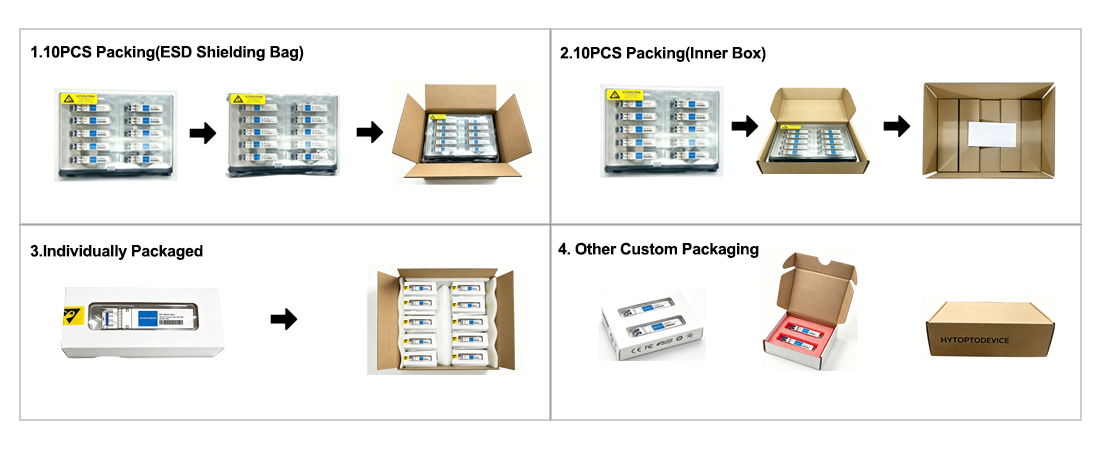
Packaging & Custom OEM Solutions
ESD Protection & Fast Shipping: Every module is sealed in an ESD-safe bag and ready for same-day dispatch from stock.
Custom OEM & Branding: We provide logo printing, private labeling, and custom packaging to help distributors and integrators build their brand—no factory investment required.
Why Network Engineers Choose HYTOPTODEVICE
HYTOPTODEVICE has supplied over 5000,000 optical transceiver modules to data centers, ISPs, and enterprise networks across 100+ countries since 2011. Every module undergoes a 72-hour burn-in test and full DDM/DOM validation before shipment.
“Phenomenal performance. We deployed 200 HYTOPTODEVICE SFP modules to replace Cisco OEMs in our backbone network. Result? Zero compatibility issues and a 60% reduction in costs. Highly recommended for mission-critical networks."— Senior Network Engineer, Regional Telecom, Australia
Quality Certification & Compliance
At HYTOPTODEVICE, our quality commitment is backed by industry-standard validations. From fiber optical transceiver manufacturing to final visual inspection, from IQC、IPQC、FQC to OQC, our processes ensure global compliance and reliability.
We adhere to rigorous standards for our SFP modules and network solutions:
ISO 9001: Certified quality management and production consistency.
CE & FCC: Fully compliant for seamless Global Market Access.
RoHS: Committed to environmental responsibility and hazardous material control.
Proven Reliability: Rigorous testing to reduce compliance risk and ensure safety.
Certified Quality. Global Standards. Guaranteed Performance.