Q1: What are the key deployment differences between 100G CWDM4 and 100G LR4 transceivers for Arista data centers?
A1: Tailored for Arista campus and intra-data center networking, our 100G CWDM4 modules support 2km short&medium-distance transmission with low power consumption and cost advantages. In contrast, 100G LR4 modules are designed for 10km long-distance cross-site interconnection. For 2km and under 100G link projects, our Arista-compatible CWDM4 solution delivers higher cost performance and lower operating power consumption.
Q2: Why is 100G CWDM4 a more cost-efficient option than PSM4 for mainstream Arista leaf-spine fabrics?
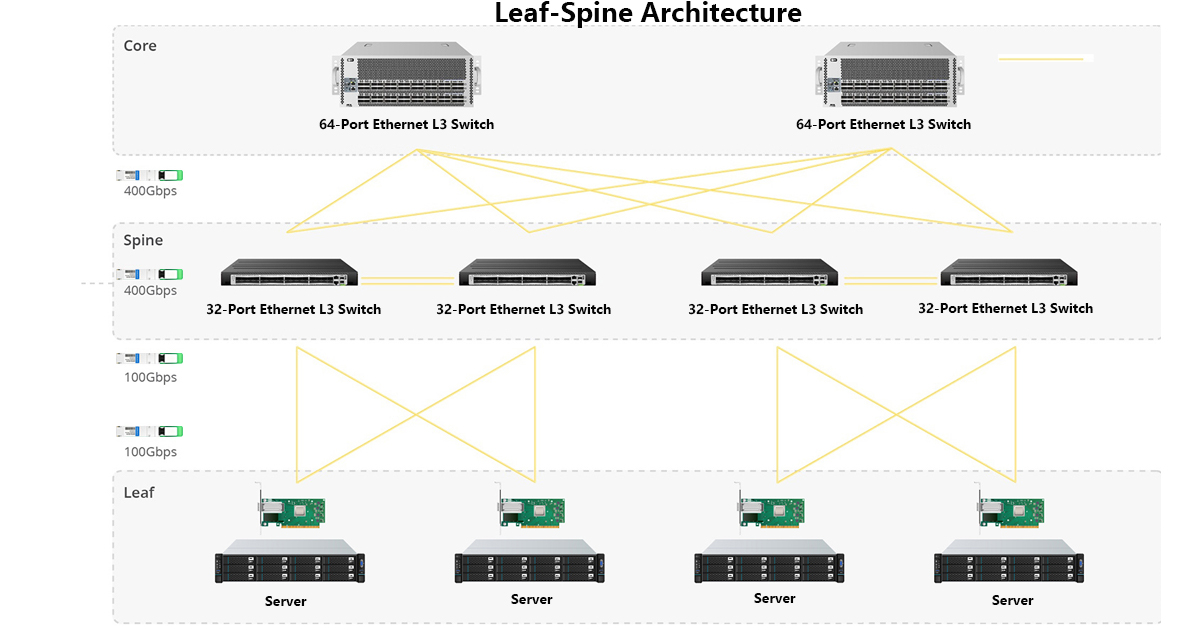
A2: PSM4 modules only support a maximum 500m transmission distance, limiting Arista cabinet-to-cabinet deployment. Our 100G CWDM4 QSFP28 module extends the reach to 2km, covering almost all intra-data center and campus DCI scenarios. With unified batch quality and affordable bulk pricing, it effectively reduces repeated hardware investment and overall network upgrade costs for Arista fabric architectures.
Q3: Can I deploy 100G CWDM4 QSFP28 modules on OM3/OM4 multimode fiber links?
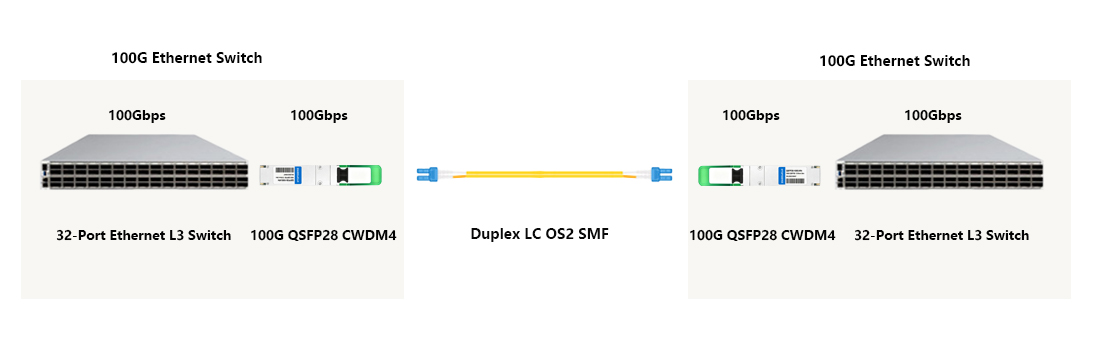
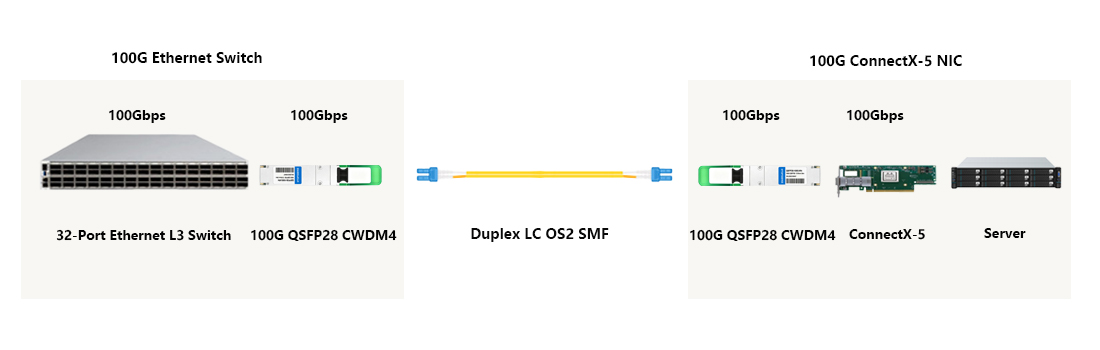
A3: Deployment on multimode fiber is not feasible. Our Arista-certified 100G CWDM4 transceivers are engineered exclusively for OS2 single-mode fiber. OM3/OM4 multimode fiber cannot support CWDM4 wavelength transmission, causing severe signal loss, unstable optical power, and frequent link flutters that fail to meet 100G business transmission standards.
Q4: Is mismatched pairing of 100G CWDM4 and 100G LR4 transceivers acceptable for Arista 100G links?
A4: We strictly advise against asymmetric transceiver pairing for formal Arista network operation. CWDM4 and LR4 adopt different wavelength schemes, optical power budgets and receiving sensitivity parameters. Cross-model pairing will trigger optical power mismatch and random bit errors. Our matched end-to-end CWDM4 modules ensure zero-error, stable long-term operation for Arista 100G links.
Q5: Why do DDM monitoring readings show minor wavelength deviations on CWDM4 transceiver ports?
A5: Tiny wavelength fluctuations are normal for commercial optical modules within industry tolerance ranges. Our Arista-compatible CWDM4 modules undergo precise wavelength calibration and aging screening before delivery. Slight DDM data deviations will not impact link stability, bandwidth performance or long-term service life in actual Arista network operation.
Q6: What is the allowable optical loss threshold for stable 2km 100G CWDM4 fiber links?
A6: Our QSFP-100G-CWDM4 compatible modules feature a standardized industrial power budget for 2km single-mode links. The total optical loss generated by fiber fusion, jumpers and patch panel interfaces must be controlled within the standard specification. This design guarantees error-free full-speed 100G transmission and stable link status for Arista switch networking.
Q7: How to troubleshoot persistent low Rx power on CWDM4 links after routine fiber cleaning?
A7: If fiber cleaning fails to restore normal receiving power, check for excessive fiber bending, aging fiber cores or loose port contact. Our factory-tested CWDM4 modules maintain highly sensitive and stable receiving performance. We provide professional one-on-one technical troubleshooting for bulk clients to quickly resolve link power anomalies and restore normal network operation.
Q8: Is surface heating of CWDM4 QSFP28 modules during long-time operation normal?
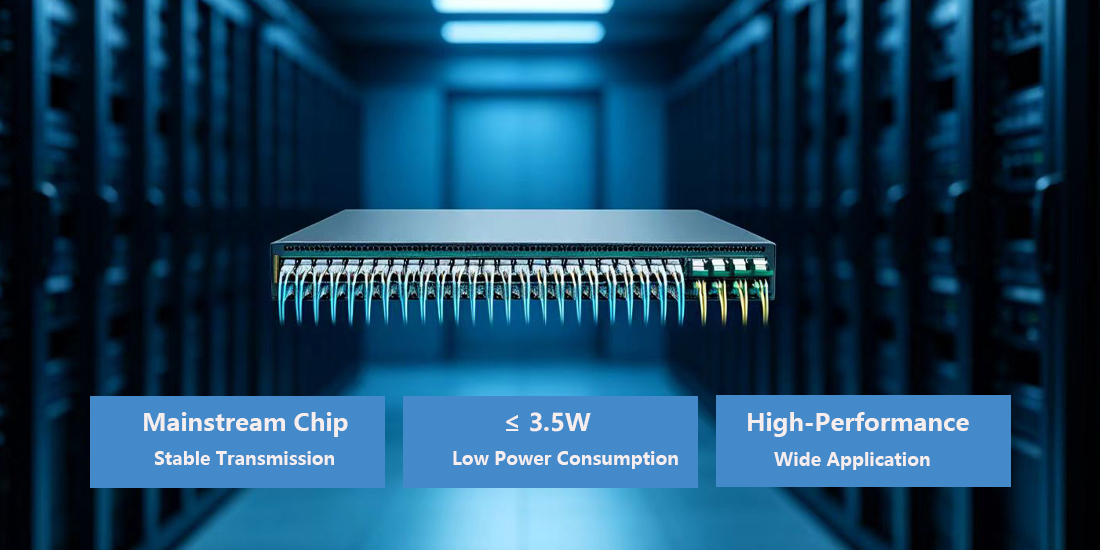
A8: Moderate heat generation is a normal physical phenomenon for high-speed 100G transceivers. Our modules adopt optimized 3.5W low-power circuitry and excellent heat dissipation structure. All products pass strict high and low temperature cycling tests, ensuring no overheating faults and stable 24/7 continuous operation in standard Arista data center environments.
Q9: Do third-party compatible CWDM4 modules compromise performance compared with original Arista OEM transceivers?
A9: There is no performance or stability gap. Our Arista-matched CWDM4 modules adopt industrial-grade laser chips and fully compliant standard protocols. Each batch completes real-machine testing on Arista mainstream switches to ensure zero-alarm operation, identical to original OEM modules, while offering more competitive procurement costs for enterprise projects.
Q10: Why adopt DML laser technology for our 100G CWDM4 QSFP28 transceivers instead of EML?
A10: Our CWDM4 modules apply mature DML direct modulation laser technology, which features lower power consumption, more stable four-wavelength output and higher cost performance. Compared with EML lasers, it perfectly matches the 2km medium-distance transmission characteristics of CWDM4, fully adapting to long-term stable operation requirements of Arista data center and enterprise core networks.
Packaging & Custom OEM Solutions
-
ESD Protection & Fast Shipping: Every module is sealed in an ESD-safe bag and ready for same-day dispatch from stock.
-
Custom OEM & Branding: We provide logo printing, private labeling, and custom packaging to help distributors and integrators build their brand—no factory investment required.

Why Network Engineers Choose HYTOPTODEVICE
HYTOPTODEVICE has supplied over 5000,000 optical transceiver modules to data centers, ISPs, and enterprise networks across 100+ countries since 2011. Every module undergoes a 72-hour burn-in test and full DDM/DOM validation before shipment.
- Up to 70% cost savings vs OEM, transparent pricing & flexible bulk rates, supported quality returns
- 100% real-device compatible with Cisco, Huawei,Dell,Juniper, and Arista
- ISO 9001:2015 Shenzhen factory, full lineup: 1.25G/10G/25G/40G/100G/200G/400G/800G/1.6T transceivers
- Ample stock, fast global DHL/FedEx shipping in 3–5 working days
- Free pre-sales engineering support for custom EEPROM & private label firmware
- Real switch test videos available for pre-purchase review; inspection & shipping videos provided per order
“Phenomenal performance. We deployed 200 HYTOPTODEVICE SFP modules to replace Cisco OEMs in our backbone network. Result? Zero compatibility issues and a 60% reduction in costs. Highly recommended for mission-critical networks."— Senior Network Engineer, Regional Telecom, Australia
Quality Certification & Compliance
At HYTOPTODEVICE, our quality commitment is backed by industry-standard validations. From fiber optical transceiver manufacturing to final visual inspection, from IQC、IPQC、FQC to OQC, our processes ensure global compliance and reliability.
We adhere to rigorous standards for our SFP modules and network solutions:
-
ISO 9001: Certified quality management and production consistency.
-
CE & FCC: Fully compliant for seamless Global Market Access.
-
RoHS: Committed to environmental responsibility and hazardous material control.
-
Proven Reliability: Rigorous testing to reduce compliance risk and ensure safety.
Certified Quality. Global Standards. Guaranteed Performance.

Rigorous Industrial Product Testing

100% 3rd Party Compatible

Partial Test Demonstration