Built on MSA open standards, this 10G BiDi SFP+ works with Cisco, Arista, Huawei, H3C, Juniper, Dell, Palo Alto hardware. Well‑suited for mixed‑vendor long‑haul metro and wide‑area network expansion projects for enterprise, carrier clients, wholesalers and integrators.
Q1: Can HYTOPTODEVICE Dell GP-SFP-10GBX-U-80 BiDi modules run normally on multi-brand network devices besides Dell?
A: Yes. HYTOPTODEVICE 10G 80km BiDi modules support cross-brand compatibility with mainstream network equipment. We pre-configure exclusive EEPROM for Dell EMC devices and adopt universal MSA standard protocols for Cisco, Juniper, MikroTik, Ubiquiti and other hardware. Submit your specific device model and firmware version to the HYTOPTODEVICE technical team for free pre-deployment verification to avoid port recognition exceptions.
Q2: Will using HYTOPTODEVICE third-party optical modules void the warranty of Dell network switches and servers?
A: No. Deploying HYTOPTODEVICE compatible transceivers will not invalidate the original hardware warranty of Dell devices. Official manufacturer warranties only cover inherent hardware failures of the host equipment itself, excluding faults caused by aftermarket optical modules. Global bulk buyers can check Dell’s official warranty terms to confirm compliant usage.
Q3: Is hot-swap replacement available for this 10G Dell-compatible BiDi module in live production networks?
A: Yes. The HYTOPTODEVICE GP-SFP-10GBX-U-80 compatible module fully complies with SFF-8472 hot-swap specifications. It supports non-stop online replacement in live enterprise and carrier networks. To avoid optical port damage and laser safety hazards, always disconnect the simplex LC fiber cable before plugging or unplugging the module during maintenance.
Q4: Can DDM/DOM optical monitoring functions work fully when used with different generations of Dell EMC devices?
A: Yes. HYTOPTODEVICE integrates complete SFF-8472 compliant DDM/DOM monitoring functions for all 80km BiDi modules. All optical operating parameters can be normally displayed on mainstream Dell EMC switches and servers. A small number of low-end multi-brand devices have limited display functions, and HYTOPTODEVICE can provide official DDM test reports for project pre-evaluation.
Q5: Why do 80km long-haul BiDi transceivers adopt 1490/1550nm wavelengths instead of 1270/1330nm?
A: 80km BiDi modules select 1490/1550nm for its lower fiber attenuation performance. Fiber attenuation at 1490nm (~0.25 dB/km) and 1550nm (~0.20 dB/km) is significantly lower than at 1270/1330nm (~0.35 dB/km), making it suitable for long‑haul distances. HYTOPTODEVICE Dell-compatible modules utilize this low-loss optical window to achieve stable 80km ultra-long single-fiber transmission for enterprise metro networks.
Q6: What specifications of optical attenuator are required for short-distance bench testing of this 80km high-power BiDi module?
A: A 12‑15 dB simplex-LC optical attenuator is mandatory for bench testing HYTOPTODEVICE 80km BiDi modules on links shorter than 10km. Our transmit power ranges from -1~+4 dBm, and the APD receiver overload threshold is -7 dBm; excessive incoming optical power may burn out the APD receiver. All HYTOPTODEVICE 80km BiDi transceivers use APD receivers, so engineers must use matched attenuation accessories for short-distance debugging.
Q7: How do fiber splices and dirty connectors affect the 80km transmission performance of HYTOPTODEVICE Dell-compatible modules?
A: Additional insertion loss from multiple splices or contaminated connectors will reduce the actual effective transmission distance. The official 80km rating of HYTOPTODEVICE modules is tested on standard clean low-loss OS2 single-mode fiber without extra loss points. We recommend integrators complete on-site link budget testing before bulk deployment for complex fiber links to ensure stable long-distance transmission.
Q8: What type of optical receiver chip is built into HYTOPTODEVICE 80km Dell BiDi SFP+ modules?
A: HYTOPTODEVICE Dell GP-SFP-10GBX-U-80 compatible modules adopt professional APD avalanche photodiode receivers instead of ordinary PIN receivers. APD chips provide ultra-high receiving sensitivity that meets the signal reception requirements of 80km long-haul transmission, while PIN receivers cannot support such long-distance link budgets. All products use industrial-qualified APD components to ensure consistent batch performance.
Q9: What quality inspection processes do HYTOPTODEVICE implement for 10G 80km BiDi modules before factory delivery?
A: All HYTOPTODEVICE Dell-compatible optical modules undergo strict multi-process quality testing before shipment. Each unit completes full optical parameter calibration, DDM function debugging, 72-hour continuous power-on burn-in test, and temperature cycle aging screening. We can provide serial-number-bound test reports for global wholesalers and integrators to support incoming quality inspection and project audit.
Q10: Do 80km long-haul Dell BiDi modules generate more heat than conventional 10km short-range modules?
A: Yes. HYTOPTODEVICE 80km long-haul BiDi modules produce slightly higher heat than 10km short-range optics. Long-distance transmission requires higher laser transmit power, leading to increased power consumption and heat generation. Ensure sufficient cabinet ventilation during installation to keep the module operating within the standard 0°C-70°C temperature range for stable long-term operation.
Q11: Can commercial-grade HYTOPTODEVICE Dell BiDi modules be used for outdoor unconditioned cabinet and cell tower deployment?
A: No. Standard HYTOPTODEVICE GP-SFP-10GBX-U-80 compatible modules are commercial-grade products only, suitable for indoor constant-temperature cabinet environments. They cannot adapt to extreme temperature changes in outdoor unconditioned cabinets and cell tower sites. Contact the HYTOPTODEVICE sales team if you need industrial-temperature customized modules for harsh outdoor scenarios.
Q12: Does this Dell-compatible 80km BiDi SFP+ module have built-in FEC error correction function?
A: No. HYTOPTODEVICE 10G BiDi optical modules do not integrate on-board hardware FEC chips. The forward error correction function needs to be enabled and processed on the matched Dell switch or router host device. For long-haul links with slight signal loss, enabling device-side FEC can effectively improve link stability and anti-interference ability.
Q13: Is this 10G BiDi module applicable for OTN OTU2 and SONET OC-192 professional transmission services?
A: No. HYTOPTODEVICE Dell-compatible 80km BiDi modules are professionally designed and verified for 10GBASE-Ethernet business scenarios. They do not support OTN OTU2/OTU2e and SONET OC-192 transport protocols. Using the module for non-Ethernet services will cause signal mismatch and unstable link flapping.
Q14: Why are 80km long-haul BiDi optical modules more costly than mainstream 10km short-range modules?
A: 80km BiDi modules like HYTOPTODEVICE Dell GP-SFP-10GBX-U-80 compatible optics have higher comprehensive production costs. Long-haul models require high-power laser transmitters and high-sensitivity APD receivers, with stricter component screening and precision calibration processes. Meanwhile, the market demand for 80km long-distance BiDi products is smaller than short-range models. As a direct factory supplier, HYTOPTODEVICE provides ultra-cost-effective bulk wholesale prices for global distributors.
Q15: What causes link failure when DDM optical power data of HYTOPTODEVICE Dell BiDi modules is within the normal range?
A: Normal optical power readings cannot guarantee successful link establishment. The main hidden causes include mismatched BiDi wavelength pairing, inconsistent device FEC mode settings, port speed negotiation failures, patch cable polarity errors, and Dell device third-party transceiver interception rules. HYTOPTODEVICE provides professional troubleshooting guidelines to help integrators quickly locate and solve on-site link problems.
Why Network Engineers Choose HYTOPTODEVICE
HYTOPTODEVICE has supplied over 5000,000 optical transceiver modules to data centers, ISPs, and enterprise networks across 100+ countries since 2011. Every module undergoes a 72-hour burn-in test and full DDM/DOM validation before shipment.
- Up to 70% cost savings vs OEM, transparent pricing & flexible bulk rates, supported quality returns
- 100% real-device compatible with Cisco, Huawei,Dell,Juniper, and Arista
- ISO 9001:2015 Shenzhen factory, full lineup: 1.25G/10G/25G/40G/100G/200G/400G/800G/1.6T transceivers
- Ample stock, fast global DHL/FedEx shipping in 3–5 working days
- Free pre-sales engineering support for custom EEPROM & private label firmware
- Real switch test videos available for pre-purchase review; inspection & shipping videos provided per order
“Phenomenal performance. We deployed 200 HYTOPTODEVICE SFP modules to replace Cisco OEMs in our backbone network. Result? Zero compatibility issues and a 60% reduction in costs. Highly recommended for mission-critical networks."— Senior Network Engineer, Regional Telecom, Australia
Quality Certification & Compliance
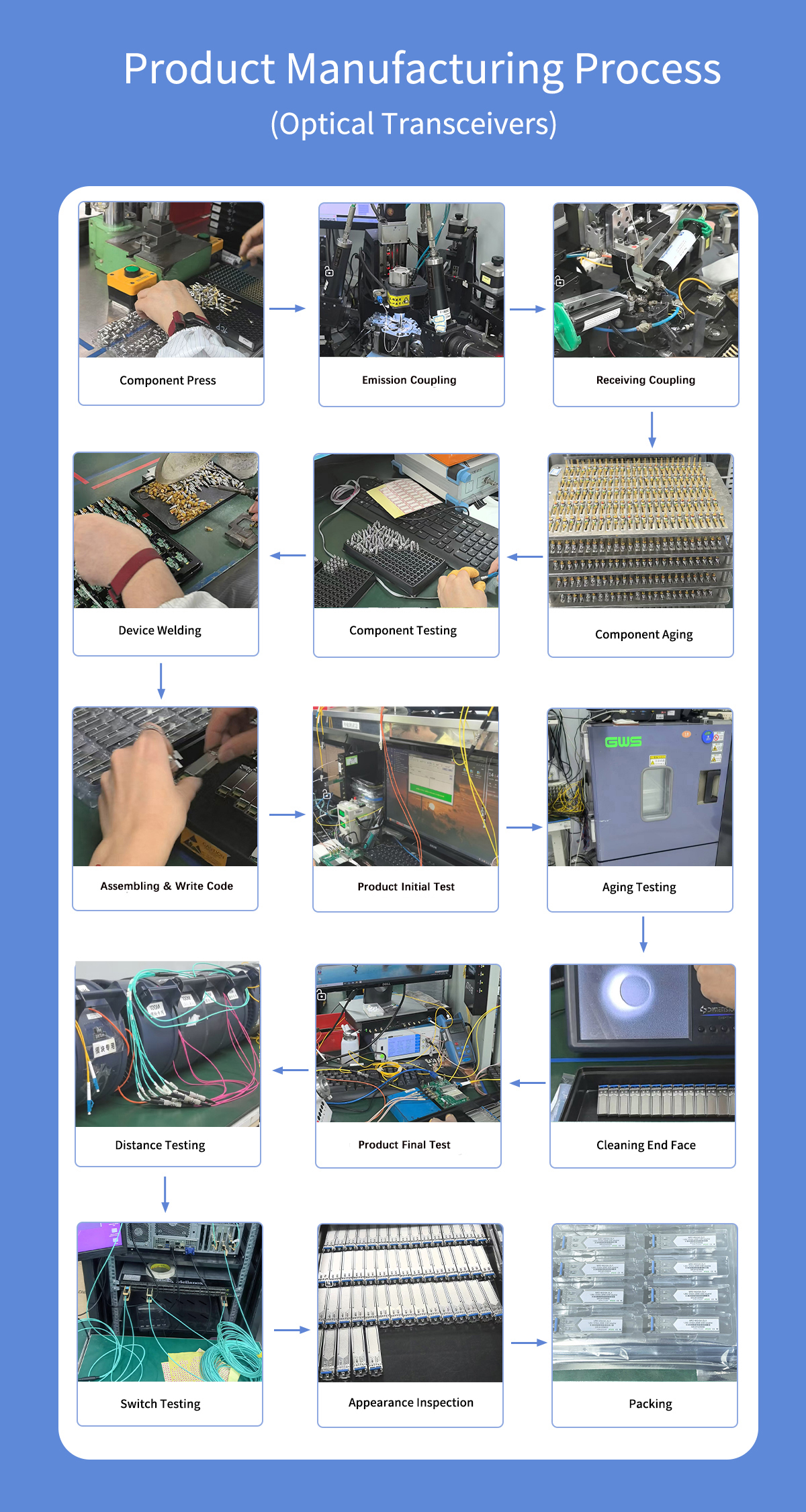
At HYTOPTODEVICE, our quality commitment is backed by industry-standard validations. From fiber optical transceiver manufacturing to final visual inspection, from IQC、IPQC、FQC to OQC, our processes ensure global compliance and reliability.
We adhere to rigorous standards for our SFP modules and network solutions:
-
ISO 9001: Certified quality management and production consistency.
-
CE & FCC: Fully compliant for seamless Global Market Access.
-
RoHS: Committed to environmental responsibility and hazardous material control.
-
Proven Reliability: Rigorous testing to reduce compliance risk and ensure safety.
Certified Quality. Global Standards. Guaranteed Performance.

Rigorous Industrial Product Testing

100% 3rd Party Compatible

Partial Test Demonstration

Others