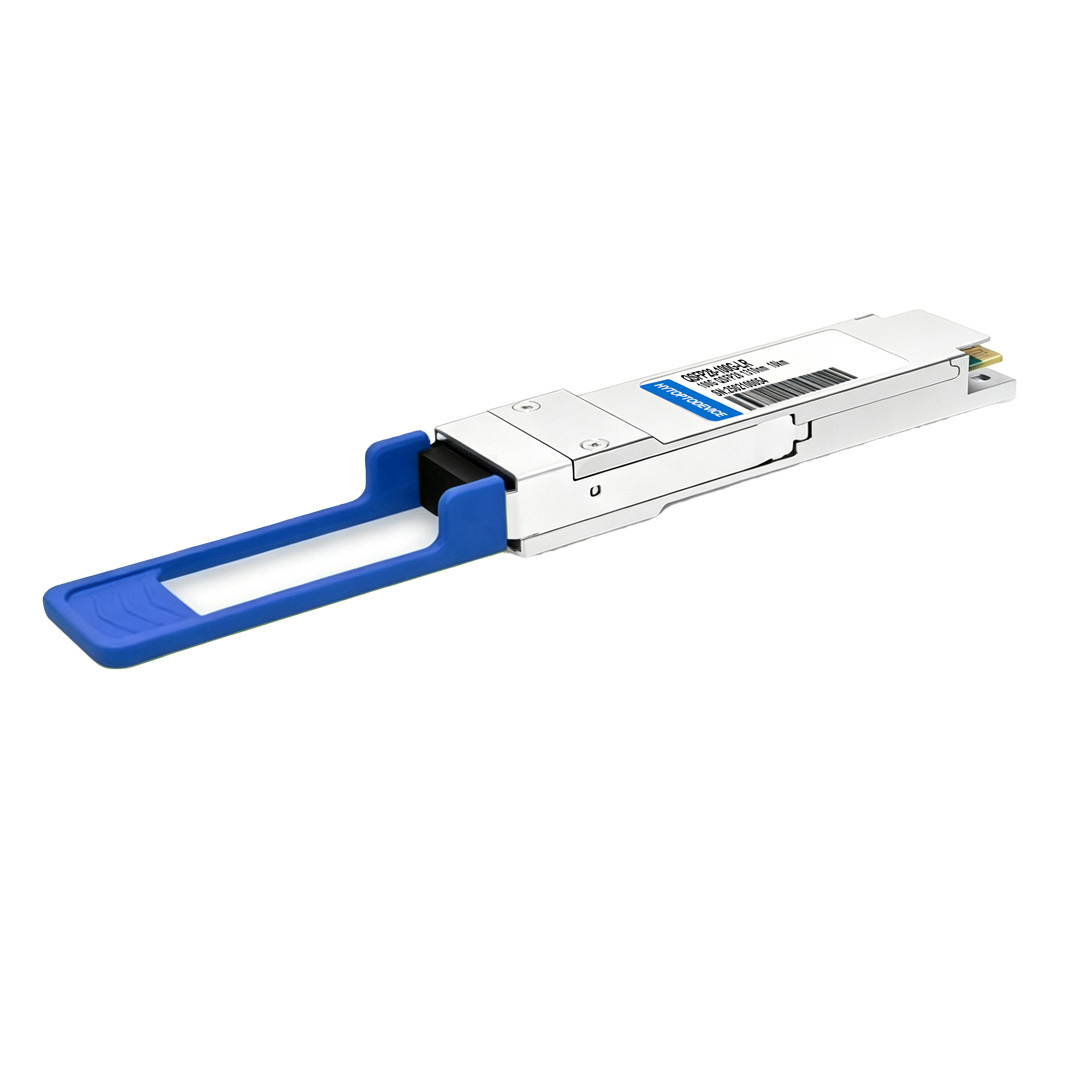
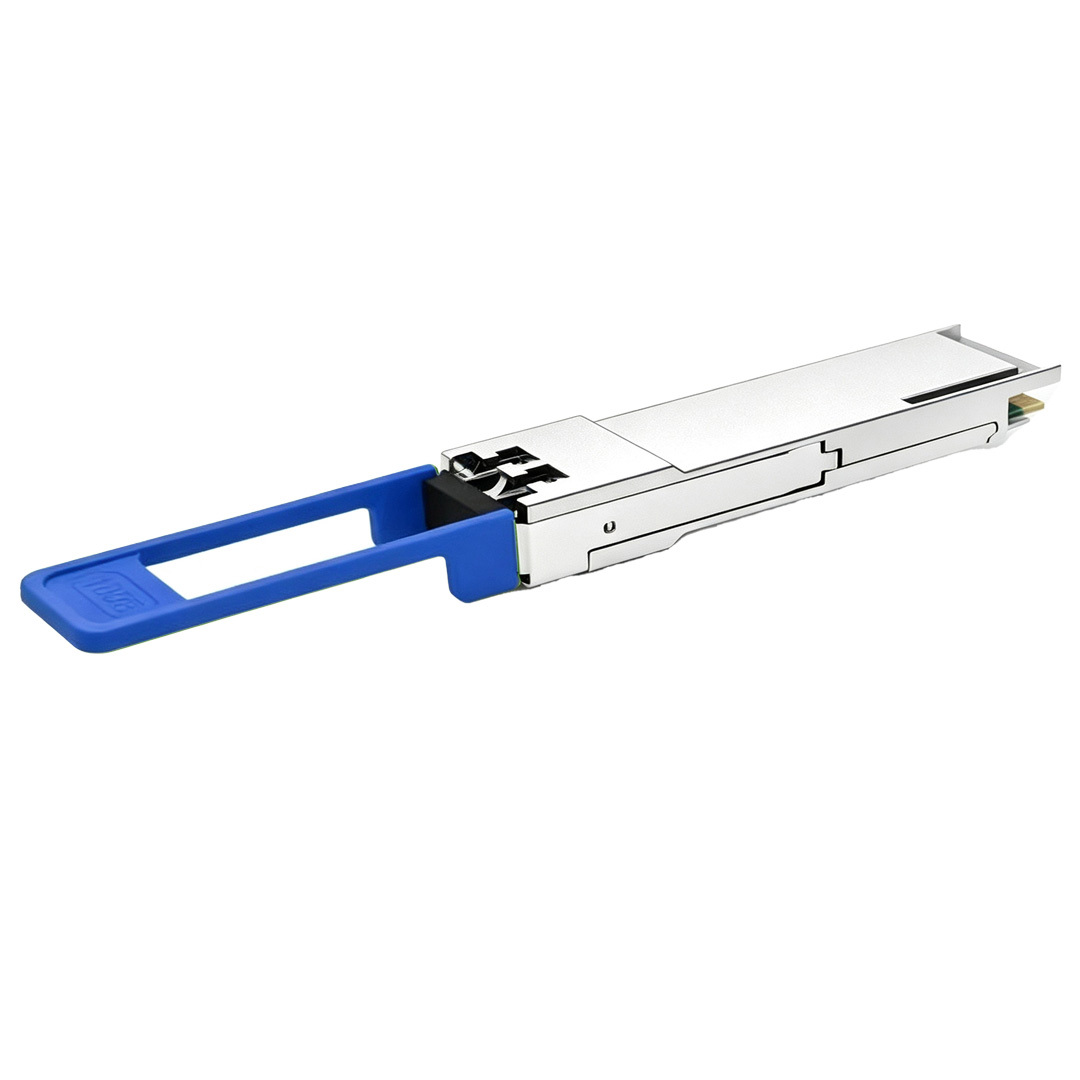
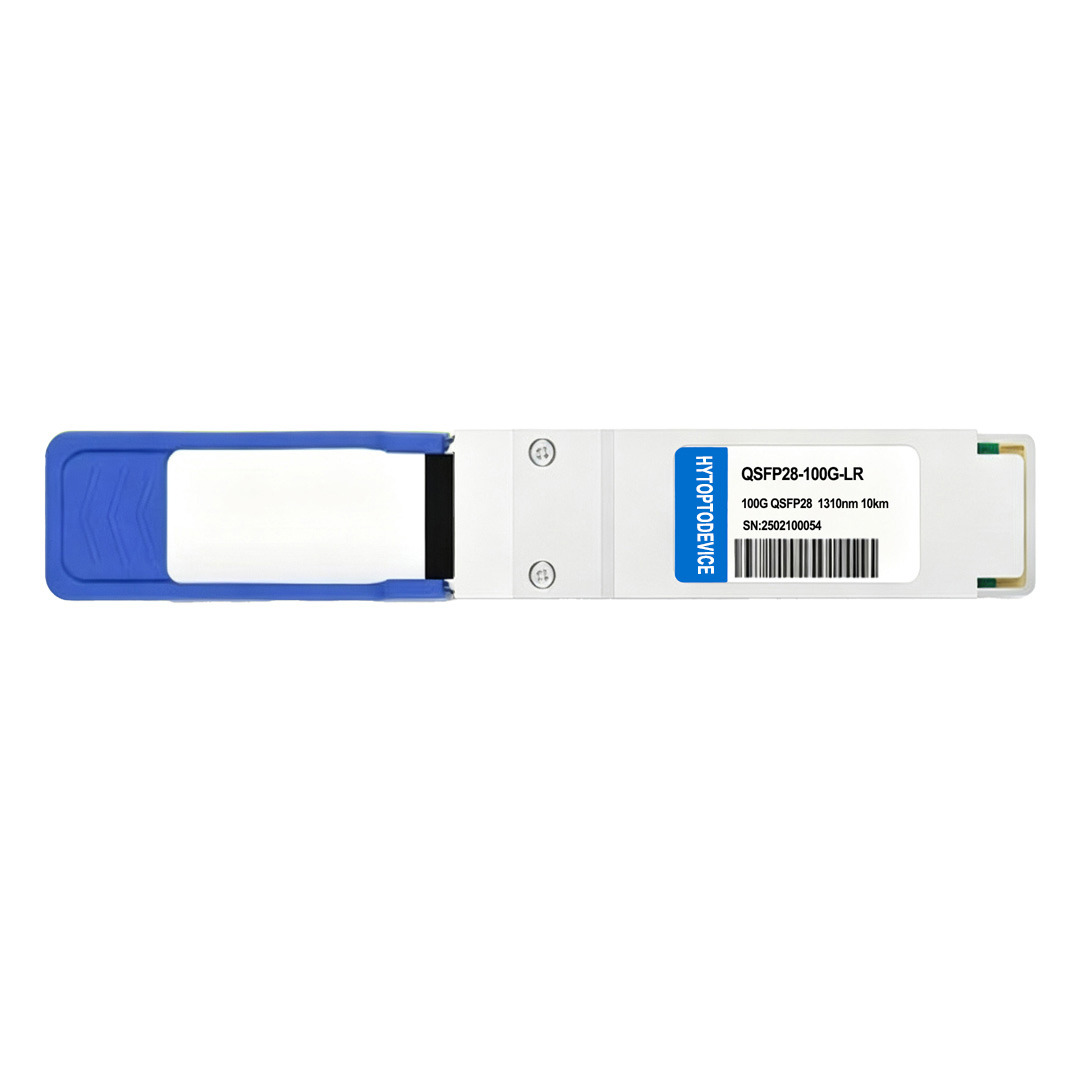
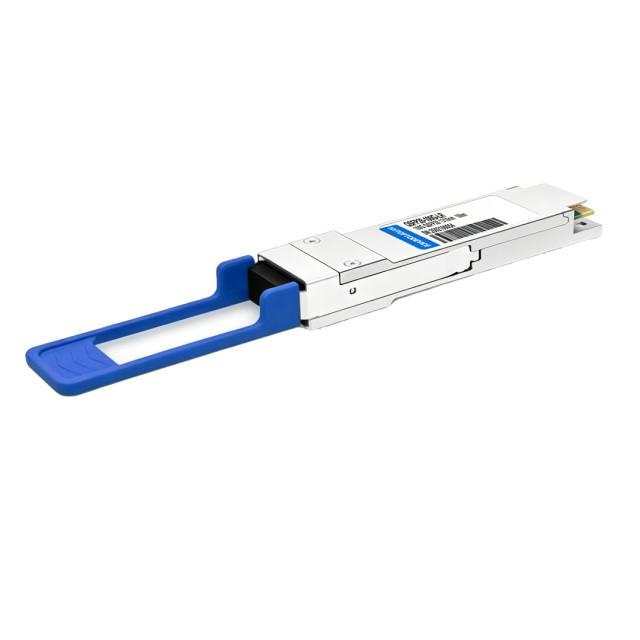
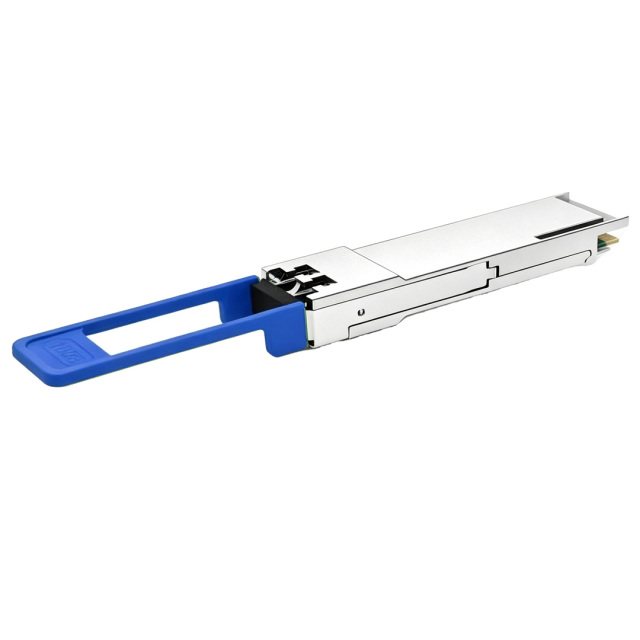
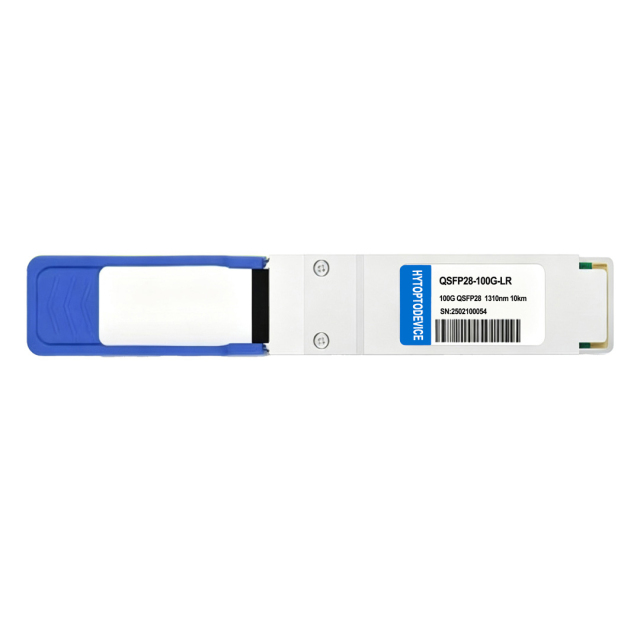
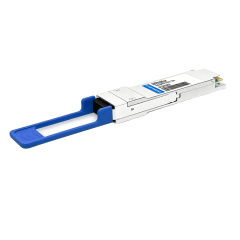
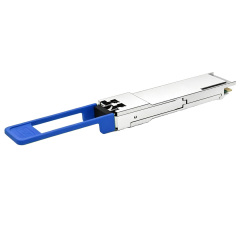
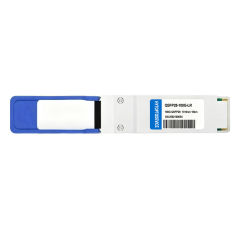
Juniper QSFP-100G-LR Compatible 100G QSFP28 LRTransceiver Module Single Lambda | 100GBASE-LR 1310nm 10km SMF Duplex LC SMF | HYTOPTODEVICE
Product Overview
This 100G QSFP28 transceiver serves as a field-proven replacement for Juniper QSFP-100G-LR, engineered to eliminate compatibility alarms and link instability on Juniper enterprise and data center hardware.
It adopts single-lambda PAM4 modulation paired with built-in KP4 FEC, delivering consistent 100G Ethernet traffic up to 10km over OS2 single-mode fiber. The onboard DSP converts four 25G electrical lanes into one unified 100G optical channel, maintaining clean signal performance across cross-floor, campus and inter-building long-haul links.
Designed to satisfy IEEE 802.3cd, QSFP28 MSA and 100G Lambda MSA standards, the module supports DDM/DOM real-time optical monitoring. Tuned EEPROM profiles enable hot-plug operation on Juniper equipment with minimal warning logs. It fits leaf-spine fabrics, long-distance aggregation trunks and phased bandwidth expansion via valid 400G PLR4 optical breakout.
Key Technical Specifications
| Juniper Compatible |
QSFP-100G-LR1 |
Vendor Name |
HYTOPTODEVICE |
| Form Factor |
QSFP28 |
Max Data Rate |
100Gbps Single Lambda |
| Wavelength |
1310nm
|
Max Distance |
10km |
| Connector |
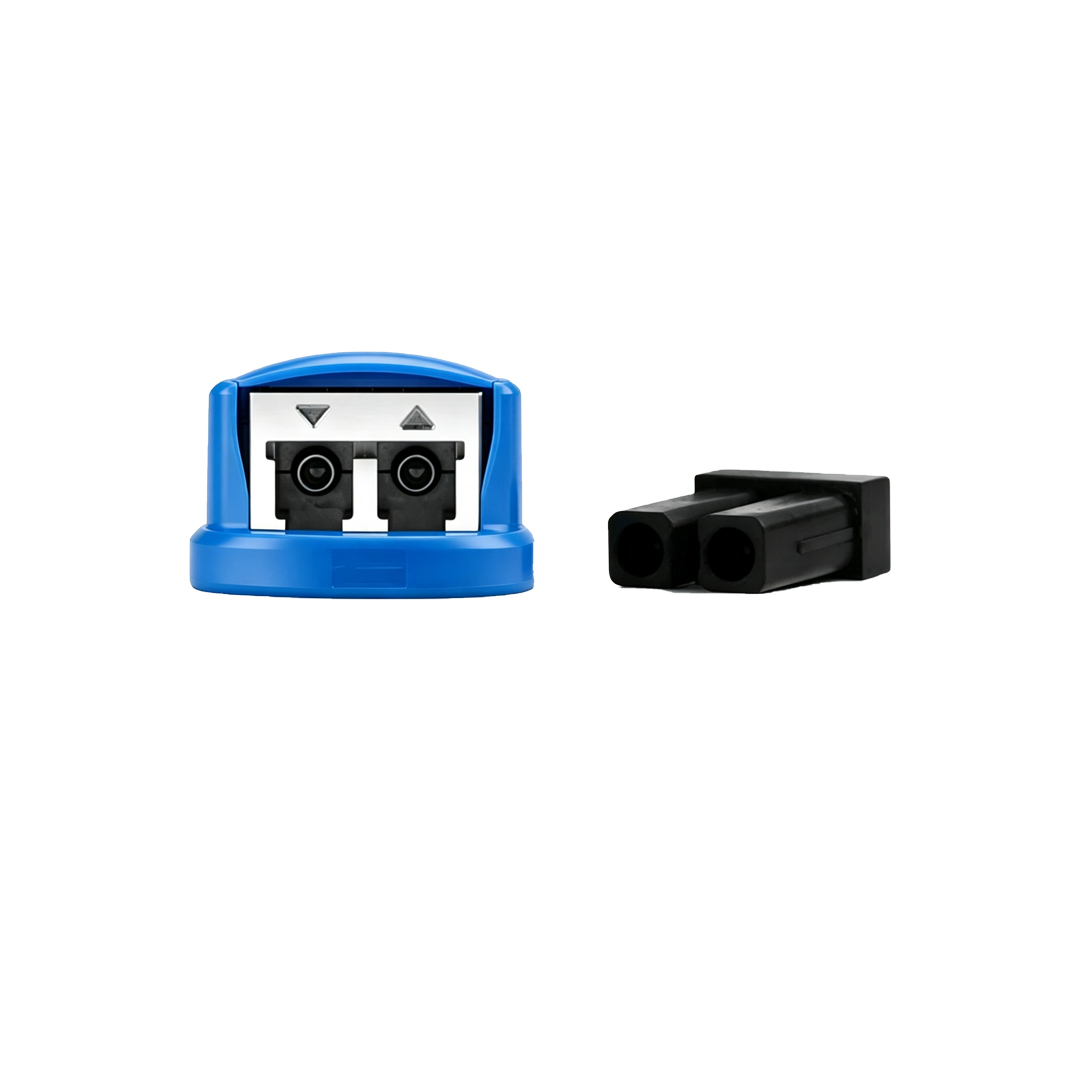
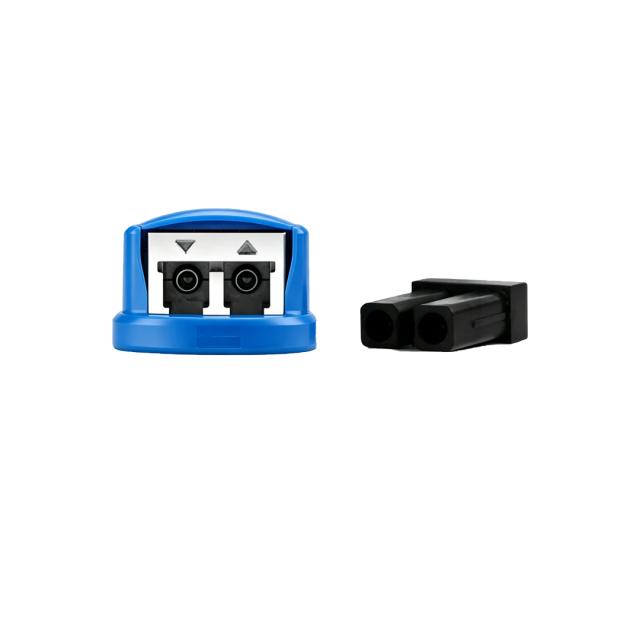
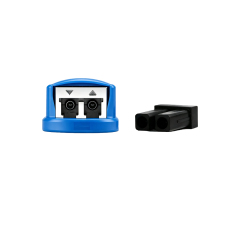
Duplex LC/UPC |
Transmitter Type |
EML |
| Cable Type |
SMF |
Receiver Type |
PIN |
| FEC Support |
Yes |
TX Power |
-1.4~+4.5dBm |
| Power Consumption |
<4.5W |
Receiver Sensitivity |
< -6.1dBm |
| Protocols |
QSFP28 MSA, SFF-8636,IEEE 802.3cu,CAUI-4 |
Operation Temperature |
0 to 70°C (32 to 158°F) |
Usage Guidelines & Best Practices
- Fiber Requirement: Only OS2 single-mode fiber; OM3/OM4 multimode fiber cannot support 1310nm PAM4 transmission and will cause link failure.
- FEC Configuration: Enable KP4 FEC on Target switch ports to maximize 10km link margin and sustain low BER stability.
- Installation Specification: Hot-plug supported; keep LC end faces clean and maintain proper bend radius to avoid extra attenuation.
- Distance Limit: Rated for 10km OS2 SMF; excessive splices, contaminated connectors or tight bends reduce effective transmission distance.
- Optical Attenuator Required for Short Links: For testing or short‑distance connections (<5km), connect a 2dB optical attenuator to the RX port to prevent damaging the receiver,ensuring the received power between -6.1~+4.5dBm.
- Operating Environment: Commercial temperature 0°C–70°C; keep ports dry and dust-free to extend QSFP28 transceiver service life.
For detailed operation instructions, please refer to the User Guide.
Full Compatibility List & Supported Network Hardware
1. Supported Hardware & Firmware
HYTOPTODEVICE QSFP-100G-LR compatible QSFP28 transceivers match original mechanical dimensions and optical parameters. Purpose-built EEPROM configuration enables plug-and-play operation on Juniper EX and QFX series switches. Every unit passes lab interoperability testing to suppress unknown module alerts, port flapping and random session interruptions.
Validated Juniper Platforms:
- Juniper QFX leaf and spine data center switches
- Juniper EX series enterprise core and aggregation switches
- Rack servers equipped with QSFP28 100G NIC ports
- All hardware with standard QSFP28 ports supporting 100GBASE-LR1 single lambda
2. Multi-Brand Cross Compatibility
Built on universal MSA specifications, these QSFP-100G-LR-S replacement QSFP28 transceivers support broad multi-vendor interoperability. They work seamlessly with Arista, Cisco, Juniper, H3C, Huawei,Dell, NVIDIA/Mellanox hardware and other more, supporting multi‑vendor hybrid networking and flexible long‑reach 100G data‑center deployment.
3. Free Value-Added Services
-
Custom firmware for multi-device compatibility
-
Support sample testing before bulk orders for project pre-verification
-
Private-label customization and professional deployment guidanc
-
Strict batch consistency quality control
- Free custom EEPROM programming for special and legacy network environments
- Free EEPROM rewriting (Tools Included) with 24/7 Tech Support
Primary Application Scenarios
- Leaf-spine fabric inter-switch connections for Juniper rack-scale data centers
- Long-haul 100G Ethernet links across multi-building enterprise campuses
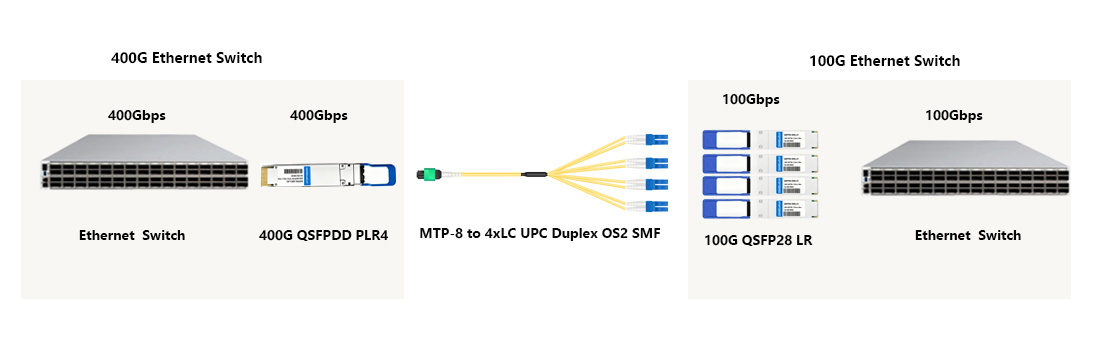
- 400G PLR4 to 4×100G optical breakout for gradual bandwidth expansion
- 100G uplinks between top-of-rack switches and Huawei GPU, HPC and virtualization servers
- Enterprise core and aggregation backbone extension over 10km single-mode fiber
- Multi-vendor hybrid infrastructure long-distance interconnection
Connectivity Solutions(Applications)
1. 100G to 100G for Switch-Switch Interconnection

2.100G to 100G for Switch-NIC Connection

3.100G to 400G Smooth Network Migration
The Core Feature
1.Phased upgrade without full infrastructure replacement
Single-lambda PAM4 design and standard KP4 FEC enable seamless 400G FR4 breakout migration. Customers scale bandwidth batch by batch while reusing target switching and fiber assets, maximizing hardware utilization and cutting total TCO.
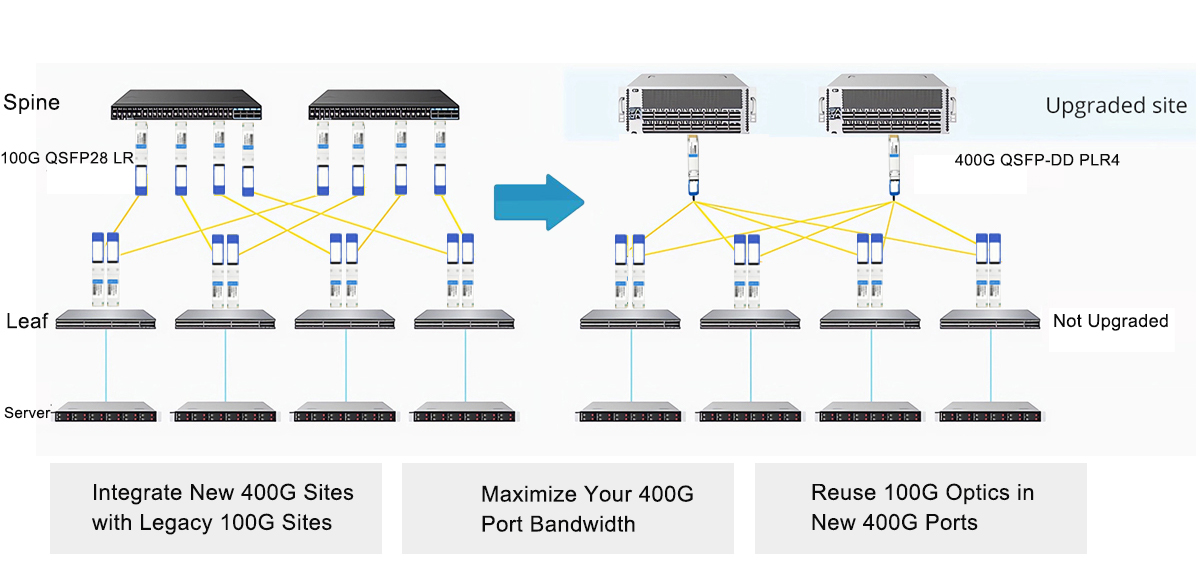
2.Verified Host Interoperability
EEPROM firmware pre-coded to your target host. Every QSFP28 is real-machine verified across host generations. Plug in, power up — zero alarms, zero re-work. No link flapping. No port lockdowns. No compatibility errors. Legacy or current hardware, same clean result.

3.Comprehensive Factory Testing & Reliable Performance
100% factory tested, not sampled. Optical eye, TX/RX power, wavelength, sensitivity, EEPROM/DDM. Full burn-in plus wide-temp testing. Traceable test data. Reliable now, reliable years on.
Curious how? Tour the Test Center.

FAQ
Q1: What architectural distinctions separate 100G LR1 single-lambda optics from legacy 100G LR4 modules?
A: HYTOPTODEVICE 100G LR1 carries the complete 100G payload on one 1310nm PAM4 channel via duplex LC fiber. LR4 partitions traffic onto four distinct wavelengths relying on multiplexing hardware. The streamlined LR1 design lowers cabling complexity and component expenditure, yet the two variants cannot communicate directly over fiber due to incompatible lane frameworks.
Q2: Which formal specifications govern the electrical and optical operation of 100G LR1 QSFP28 transceivers?
A: Our Juniper-compatible 100G LR1 QSFP28 complies with IEEE 802.3cd, QSFP28 MSA and 100G Lambda MSA. These unified global standards standardize mechanical form factor, PAM4 signaling, KP4 FEC execution and DDM diagnostics, ensuring consistent performance across Juniper and other mainstream switching ecosystems.
Q3: What fiber connector interface is adopted by modern 100G LR1 optical transceivers?
A: HYTOPTODEVICE 100G LR1 QSFP28 transceivers employ duplex LC/UPC connectors. This compact dual-fiber interface suits densely populated racks and enables bidirectional 1310nm single-lambda transmission over standard OS2 single-mode fiber.
Q4: Do both ends of a 100G LR1 fiber link have to use switches from the same vendor?
A: Matching switch manufacturers are not mandatory. HYTOPTODEVICE standardized 100G LR1 optics offer reliable cross-vendor interoperability. Stable connectivity holds as long as both sides deploy standard LR1 modules and align KP4 FEC configurations; mismatched transceiver types or inconsistent FEC modes still trigger unstable links.
Q5: Are optical attenuators necessary to protect receivers on short 100G LR1 links around 500 meters?
A: Attenuators are generally unnecessary for typical 500m OS2 spans. Properly calibrated HYTOPTODEVICE LR1 modules do not overload receivers under normal operating conditions. Continuously monitor DDM receive power values; install attenuators only when readings exceed the maximum safe input threshold.
Q6: Why do PAM4-based 100G LR1 connections demand cleaner fiber end faces than older NRZ 100G systems?
A: PAM4 packs more data within identical optical bandwidth and operates with narrower noise margins compared to traditional NRZ transmission. Even tiny dust particles, scratches or residue on LC tips create subtle waveform distortion, raising bit error rates and generating intermittent packet loss. HYTOPTODEVICE recommends regular fiber inspection and cleaning for all PAM4 deployments.
Q7: What power consumption can network operators expect from production-grade 100G LR1 QSFP28 transceivers?
A: HYTOPTODEVICE 100G LR1 modules maintain steady operating power below 4.5W. The energy-efficient design lessens thermal accumulation in fully populated switch shelves, eases cooling loads and sustains reliable DDM telemetry during 10km PAM4 transmission with KP4 FEC active.
Q8: Will fully loading all high-density switch ports with 100G LR1 modules introduce thermal hazards?
A: Individual modules produce modest heat output, yet complete port occupation creates concentrated hot zones. Insufficient chassis airflow, blocked vents or compact rack stacking lift module operating temperatures, shrink optical margin and accelerate laser aging. Thoughtful thermal layout is essential for large-scale deployments.
Q9: What factors influence the choice between EML and Silicon Photonics designs for 100G LR1 deployments?
A: Silicon Photonics LR1 modules feature compact packaging, lower power draw and superior scalability for dense leaf-spine racks. EML alternatives deliver higher optical power budget and stronger tolerance for lossy fiber plants with numerous splices. HYTOPTODEVICE supplies both technical paths; selection depends on rack density, existing fiber quality and overall link loss budget.
Q10: What practical field tests quickly judge 100G LR1 module health during routine maintenance?
A: Track DDM data for stable transmit/receive power and temperature under continuous line-rate traffic. Enable KP4 FEC and monitor BER for an extended period. All HYTOPTODEVICE units pass thermal cycling and burn-in before shipment; field modules showing drifting optical power or rising error rates should be replaced promptly.
Q11: Which 400G transceiver supports genuine optical breakout into four independent 100G LR1 links?
A: Only 400G PLR4 enables optical breakout compatible with 100G LR1 single-lambda signaling, thanks to four parallel 1310nm channels over MPO-12 fiber. 400G FR4 and LR4 use CWDM multiplexing over duplex LC and lack separate parallel lanes, so they cannot be optically split into four discrete LR1 connections.
Packaging & Custom OEM Solutions
-
ESD Protection & Fast Shipping: Every module is sealed in an ESD-safe bag and ready for same-day dispatch from stock.
-
Custom OEM & Branding: We provide logo printing, private labeling, and custom packaging to help distributors and integrators build their brand—no factory investment required.

Why Network Engineers Choose HYTOPTODEVICE
HYTOPTODEVICE has supplied over 5000,000 optical transceiver modules to data centers, ISPs, and enterprise networks across 100+ countries since 2011. Every module undergoes a 72-hour burn-in test and full DDM/DOM validation before shipment.
- Up to 70% cost savings vs OEM, transparent pricing & flexible bulk rates, supported quality returns
- 100% real-device compatible with Cisco, Huawei,Dell,Juniper, and Arista
- ISO 9001:2015 Shenzhen factory, full lineup: 1.25G/10G/25G/40G/100G/200G/400G/800G/1.6T transceivers
- Ample stock, fast global DHL/FedEx shipping in 3–5 working days
- Free pre-sales engineering support for custom EEPROM & private label firmware
- Real switch test videos available for pre-purchase review; inspection & shipping videos provided per order
“Phenomenal performance. We deployed 200 HYTOPTODEVICE SFP modules to replace Cisco OEMs in our backbone network. Result? Zero compatibility issues and a 60% reduction in costs. Highly recommended for mission-critical networks."— Senior Network Engineer, Regional Telecom, Australia
Quality Certification & Compliance
At HYTOPTODEVICE, our quality commitment is backed by industry-standard validations. From fiber optical transceiver manufacturing to final visual inspection, from IQC、IPQC、FQC to OQC, our processes ensure global compliance and reliability.
We adhere to rigorous standards for our SFP modules and network solutions:
-
ISO 9001: Certified quality management and production consistency.
-
CE & FCC: Fully compliant for seamless Global Market Access.
-
RoHS: Committed to environmental responsibility and hazardous material control.
-
Proven Reliability: Rigorous testing to reduce compliance risk and ensure safety.
Certified Quality. Global Standards. Guaranteed Performance.

Rigorous Industrial Product Testing

100% 3rd Party Compatible

Partial Test Demonstration