| NO. | Brand | Compatible P/N | Transceiver Type |
| 1 | Cisco | QSFP-200G-FR4-S | QSFP56-200G-SR4 |
| 2 | Arista | QSFP-200G-FR4 | QSFP56-200G-LR4 |
| 3 | Huawei | QSFP56-200G-FR4 | QSFP56-200G-ER4 |
| 4 | H3C | QSFP56-200G-FR4-WDM1300 | |
| 5 | Broadcom | QSFP56-200G-FR4 | |
| 6 | Generic | QSFP56-200G-FR4 |
| Huawei Compatible |
QSFP56-200G-FR4 |
Vendor Name | HYTOPTODEVICE |
| Form Factor | QSFP56 | Max Data Rate | 200Gbps (4x50Gbps) |
| Wavelength | 1271nm, 1291nm, 1311nm and 1331nm
|
Max Distance | 2km |
| Modulation Format | PAM4 | Host Required | FEC |
| Connector | Duplex LC | Voltage Supply | 3.3V |
| Cable Type | SMF | DDM Support | Yes |
| Transmitter Type | Cooled EA-DFB | Receiver Type | PIN |
| TX Power | -5.1~+4.0dBm | Receiver Sensitivity | < -8.2dBm |
| Operation Temperature | 0 to 70°C (32 to 158°F) | Maximum Power | < 6.5W |
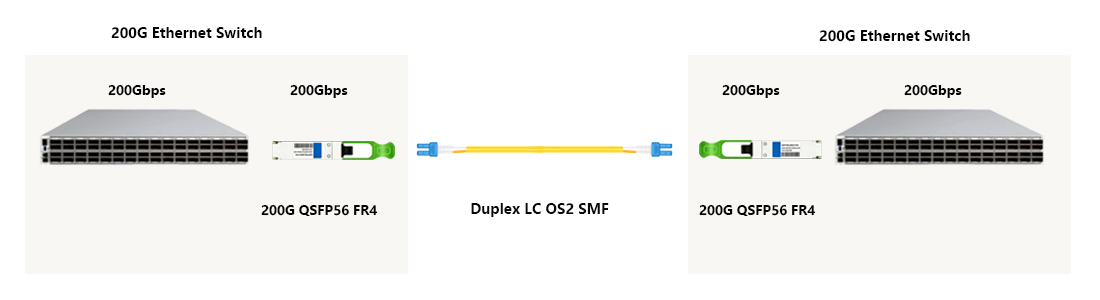
| Protocols | QSFP56 MSA, IEEE 802.3bs 200GBASE-FR4 |
Application | 200G Ethernet, 200G InfiniBand HDR, Data Center,Fiber Channel |
Full Compatibility List & Supported Network Hardware
1. Supported Hardware & Firmware
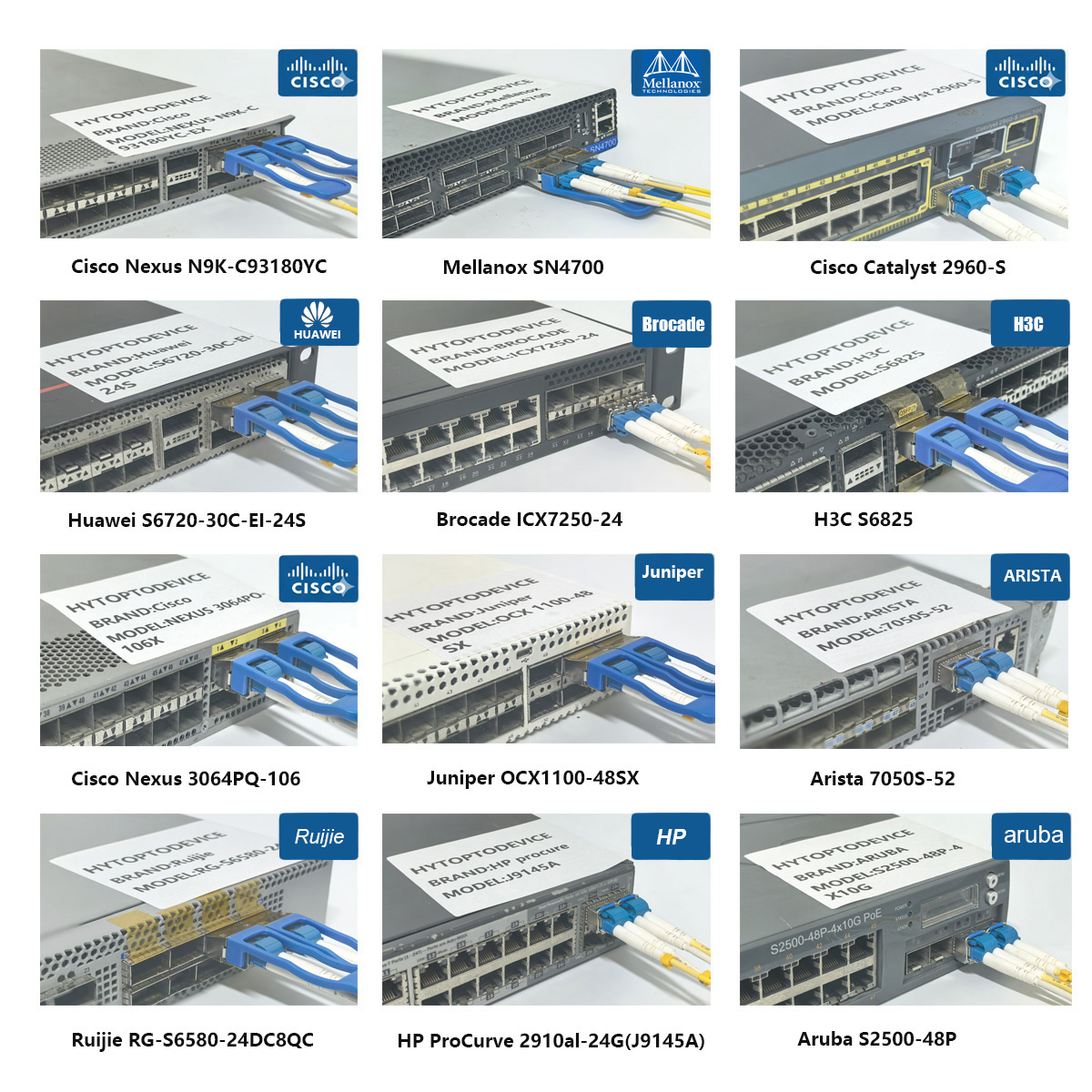
Built on universal MSA open standards, this QSFP56 FR4 transceiver is interoperable with mainstream network brands including Arista, Cisco, H3C, Huawei and more, adapting to mixed‑vendor leaf‑spine network upgrade and expansion scenarios.
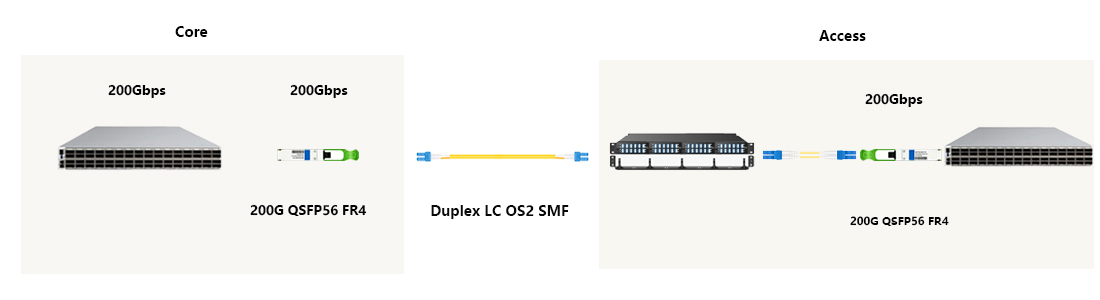


Q1: Is it worth buying more expensive FR4 optics if our link distance is well under 2 kilometers?
A: Yes, FR4 optics remain a sensible pick even for short links under 2km. HYTOPTODEVICE QSFP56 200G FR4 modules deliver standardized 200G PAM4 performance, uniform DOM monitoring and full Huawei VRP compatibility, removing risks from non-standard low-cost alternatives for wholesale data center deployments.
Q2: What happens if we try to stretch a 200G FR4 link slightly beyond its standard 2 km limit?
A: Exceeding the 2km rating will trigger rising bit error rates and intermittent link drops. 200GBASE-FR4 is calibrated for 0–2km G.652 SMF; extra fiber attenuation and dispersion cannot be offset by built-in module gain, so HYTOPTODEVICE does not recommend overreaching the distance specification.
Q3: Will using a 200G FR4 module over a very short patch cord (e.g., under 5 meters) overload or burn out the receiver?
A: It will not burn out the receiver, but excessive incoming optical power may push the receiver beyond optimal operating range. For patch cords shorter than 5m, HYTOPTODEVICE advises adding a proper optical attenuator to keep received power inside the safe window for stable PAM4 reception.
Q4: Can a 200G FR4 port interoperate directly with 100G or 400G-DR4 interfaces?
A: No, native interoperability is not supported. 200GBASE-FR4 uses unique 4-lane PAM4 CWDM4 signaling; our HYTOPTODEVICE QSFP56 200G FR4 transceiver only links to matching 200GBASE-FR4 optics and cannot auto-negotiate with 100G or 400G-DR4 ports.
Q5: Since FR4 uses PAM4 modulation, is it more vulnerable to optical noise and jitter compared to older NRZ modules?
A: Yes, PAM4 is more sensitive to noise and jitter than NRZ at the same baud rate. Our HYTOPTODEVICE QSFP56 200G FR4 modules include on-chip equalization and FEC support to suppress noise, delivering reliable performance when deployed with clean, properly terminated single-mode fiber.
Q6: How much will upgrading our access layers to 200G FR4 impact our overall rack power budget?
A: The power impact is modest. Each HYTOPTODEVICE QSFP56 200G FR4 module consumes below 6.5W maximum, so a full 32-port bank adds roughly 208W at peak, making this low-power design friendly for high-density leaf-spine rack power planning.
Q7: Will older single-mode fiber plants (like legacy G.652 fibers) support 200G FR4 without high attenuation?
A: Yes, standard legacy G.652 single-mode fiber works for 200G FR4 links up to 2km. Attenuation at the 1310nm CWDM band stays low on G.652; HYTOPTODEVICE validates all FR4 transceivers on G.652 fiber to guarantee consistent performance on existing fiber infrastructures.
Q8: Can tight cable routing inside patch panels cause signal loss on 200G FR4 links?
A: Yes, sharp bends and tight routing can introduce macro-bend loss and degrade PAM4 signal quality. We recommend following standard SMF bend-radius rules; HYTOPTODEVICE’s QSFP56 200G FR4 modules tolerate normal installation loss but cannot compensate for poorly routed, over-bent fiber.
Q9: What is the expected operating lifespan (MTBF) of these complex 4-wavelength CWDM optics?
A: The typical MTBF of our QSFP56 200G FR4 transceiver exceeds 1,000,000 hours under rated commercial temperature conditions. HYTOPTODEVICE runs long-term burn-in aging tests during production to filter early failures and secure long service life for data center uplink applications.
Q10: Are 200G FR4 transceivers prone to supply chain bottlenecks or long manufacturing lead times?
A: Lead times depend on order volume and component availability, but HYTOPTODEVICE as a direct manufacturer maintains steady stock of QSFP56 200G FR4 compatible modules. Bulk and wholesale buyers can lock in lead times and secure stable supply by placing planned orders with our sales team.
Q11: How can we verify that third-party 200G FR4 modules purchased online are genuine and not recycled components?
A: You can verify authenticity by checking DOM parameter consistency, running switch diagnostic tests and reviewing factory test reports. All HYTOPTODEVICE QSFP56 200G FR4 modules come with full test records; we do not supply refurbished or recycled optical components to our distributors and system integrators.
Q12: Can a 200G FR4 port be easily upgraded later without replacing the underlying single-mode fiber infrastructure?
A: Yes, existing G.652 SMF cabling for 200G FR4 can often be reused for future 1310nm-band upgrades. The fiber plant itself is protocol-agnostic, so buyers can preserve cabling investment when scaling bandwidth, as long as link distance and loss budgets remain acceptable.
Q13: Can we rely on the real-time temperature, voltage, and optical power telemetry reported by the module's DOM?
A: Yes, the DOM readings are calibrated and trustworthy for routine monitoring. HYTOPTODEVICE calibrates every QSFP56 200G FR4 transceiver during production; the CMIS-compliant DDM data supports daily O&M alerting and link troubleshooting for Huawei VRP networks.
Q14: Will these optics experience failures if our data center hot aisle exceeds normal temperature thresholds?
A: Extended operation above the 70°C commercial upper limit increases failure risk and shortens service life. This HYTOPTODEVICE QSFP56 200G FR4 module is commercial-grade, rated for 0~70°C; consistent thermal control in hot aisles is required to preserve stable 24/7 operation.
Q15: Are these modules certified for safe handling and environmental compliance (RoHS, Laser Class 1)?
A: Yes, our QSFP56 200G FR4 transceivers are RoHS compliant and classified as Laser Class 1. HYTOPTODEVICE supplies complete compliance certificates for bulk purchasers, distributors and integrators for data center audit and tender documentation requirements.
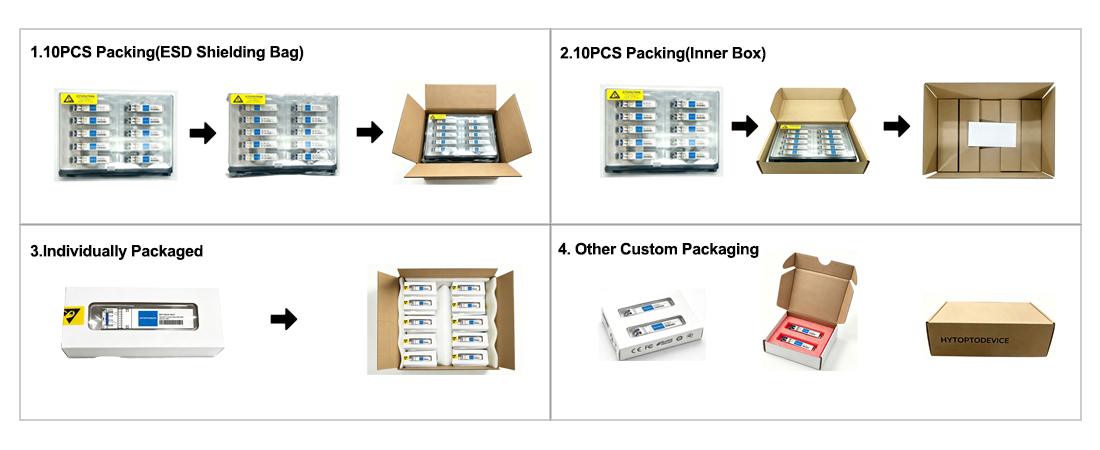
ESD Protection & Fast Shipping: Every module is sealed in an ESD-safe bag and ready for same-day dispatch from stock.
Custom OEM & Branding: We provide logo printing, private labeling, and custom packaging to help distributors and integrators build their brand—no factory investment required.
Why Network Engineers Choose HYTOPTODEVICE
HYTOPTODEVICE has supplied over 5000,000 optical transceiver modules to data centers, ISPs, and enterprise networks across 100+ countries since 2011. Every module undergoes a 72-hour burn-in test and full DDM/DOM validation before shipment.
“Phenomenal performance. We deployed 200 HYTOPTODEVICE SFP modules to replace Cisco OEMs in our backbone network. Result? Zero compatibility issues and a 60% reduction in costs. Highly recommended for mission-critical networks."— Senior Network Engineer, Regional Telecom, Australia
Quality Certification & Compliance
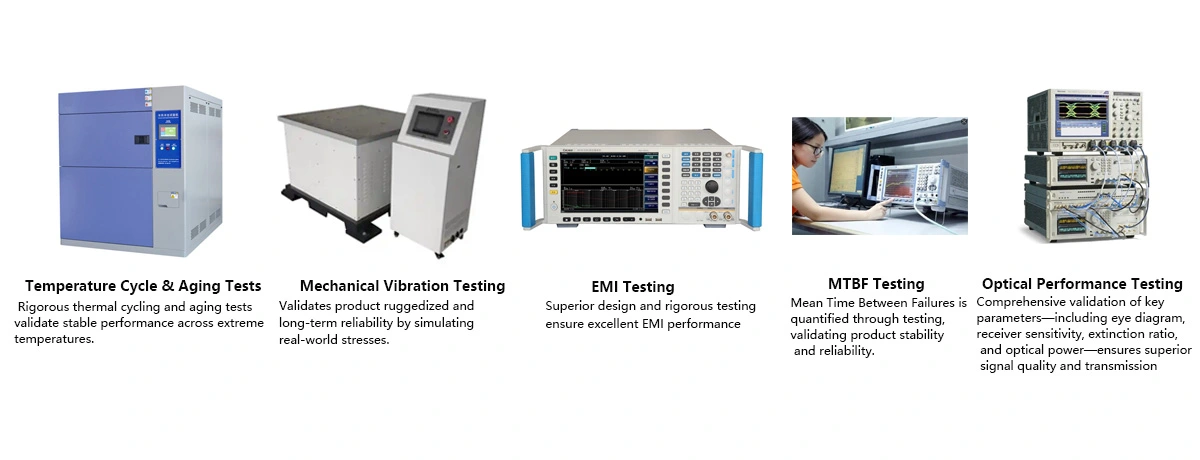
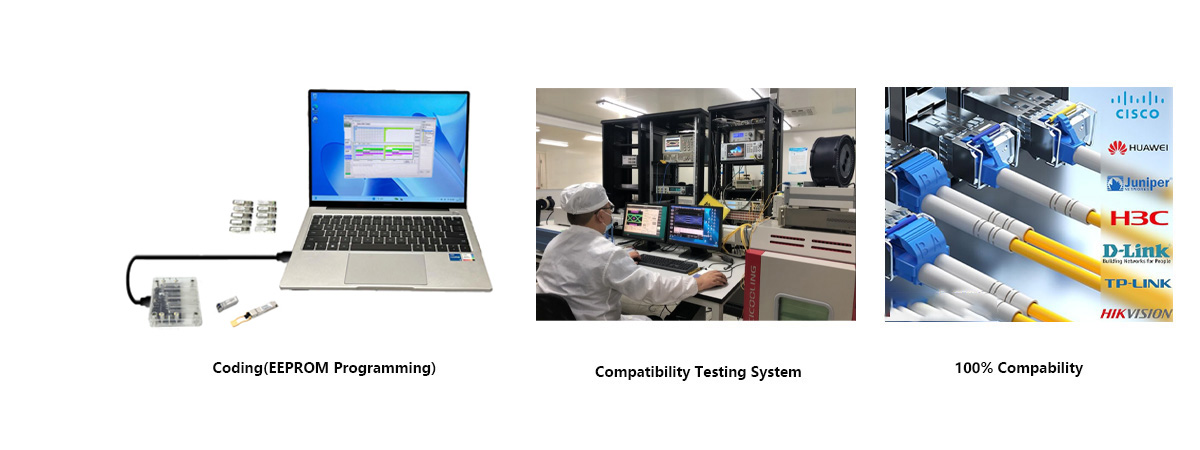
At HYTOPTODEVICE, our quality commitment is backed by industry-standard validations. From fiber optical transceiver manufacturing to final visual inspection, from IQC、IPQC、FQC to OQC, our processes ensure global compliance and reliability.
We adhere to rigorous standards for our SFP modules and network solutions:
ISO 9001: Certified quality management and production consistency.
CE & FCC: Fully compliant for seamless Global Market Access.
RoHS: Committed to environmental responsibility and hazardous material control.
Proven Reliability: Rigorous testing to reduce compliance risk and ensure safety.
Certified Quality. Global Standards. Guaranteed Performance.