


| NO. | Brand | Compatible P/N | Transceiver Type |
| 1 | Cisco | QSFP-200G-FR4-S | QSFP56-200G-SR4 |
| 2 | Arista | QSFP-200G-FR4 | QSFP56-200G-LR4 |
| 3 | Huawei | QSFP56-200G-FR4 | QSFP56-200G-ER4 |
| 4 | H3C | QSFP56-200G-FR4-WDM1300 | |
| 5 | Broadcom | QSFP56-200G-FR4 | |
| 6 | Generic | QSFP56-200G-FR4 |
| H3C Compatible |
QSFP56-200G-FR4-WDM1300 |
Vendor Name | HYTOPTODEVICE |
| Form Factor | QSFP56 | Max Data Rate | 200Gbps (4x50Gbps) |
| Wavelength | 1271nm, 1291nm, 1311nm and 1331nm
|
Max Distance | 2km |
| Modulation Format | PAM4 | Host Required | FEC |
| Connector | Duplex LC | Voltage Supply | 3.3V |
| Cable Type | SMF | DDM Support | Yes |
| Transmitter Type | Cooled EA-DFB | Receiver Type | PIN |
| TX Power | -5.1~+4.0dBm | Receiver Sensitivity | < -8.2dBm |
| Operation Temperature | 0 to 70°C (32 to 158°F) | Maximum Power | < 6.5W |
| Protocols | QSFP56 MSA, IEEE 802.3bs 200GBASE-FR4 |
Application | 200G Ethernet, 200G InfiniBand HDR, Data Center,Fiber Channel |
Full Compatibility List & Supported Network Hardware
1. Supported Hardware & Firmware
Built on universal MSA open standards, this QSFP56 FR4 transceiver is interoperable with mainstream network brands including Arista, Cisco, H3C, Huawei and more, adapting to mixed‑vendor leaf‑spine network upgrade and expansion scenarios.
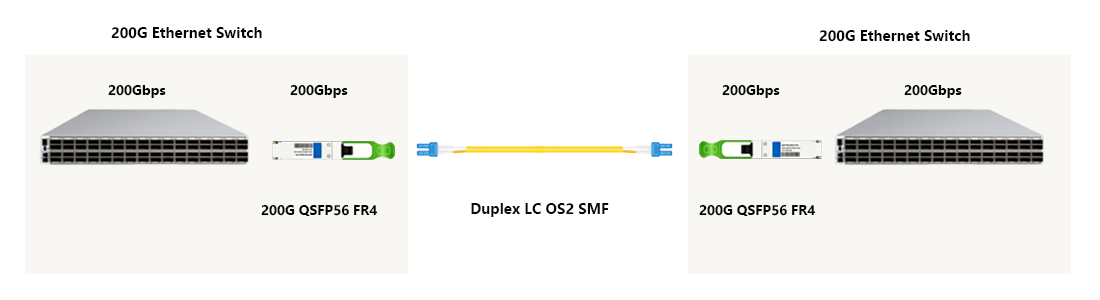
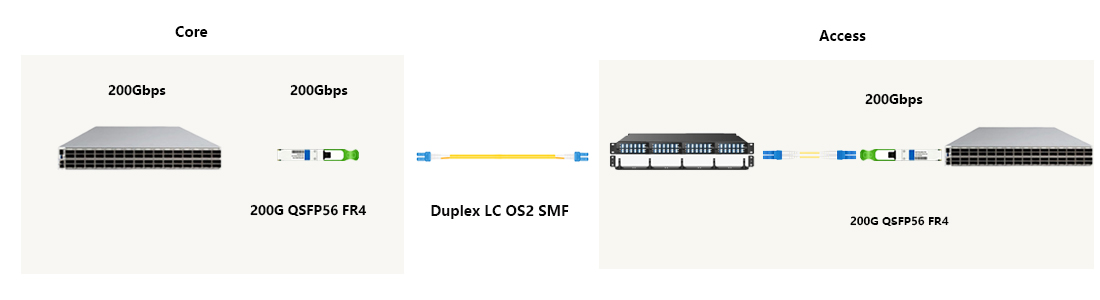


A: The cost gap comes from integrated CWDM MUX/DEMUX, single-mode DFB lasers and digital signal processor hardware. HYTOPTODEVICE 200G QSFP56 FR4 WDM1300 transceivers use four single-mode CWDM lanes, while SR4 adopts low-cost VCSEL arrays for multimode links, pushing FR4 pricing higher for SMF DCI deployments.
Q2: Is a standalone 200G FR4 link more cost-effective than dual aggregated 100G links for data center uplinks?
A: Yes, a single 200G FR4 connection reduces port count and fiber consumption. One HYTOPTODEVICE 200G QSFP56 FR4 WDM1300 module delivers 200G capacity over one duplex LC pair, lowering spending on switch licenses, fiber trunks and rack hardware for wholesale data center builds.
Q3: Can this 200G FR4 optic maintain stable connectivity for inter-building campus links?
A: No, the rated transmission distance of 200GBASE-FR4 is capped at 2km over G.652 SMF. HYTOPTODEVICE WDM1300 FR4 modules fit short campus runs under 2km; longer inter-building spans need LR4 or ER4 optical solutions instead.
Q4: Can third-party 200G FR4 optics run seamlessly on multi-vendor switching platforms without alert messages?
A: Compatibility warnings depend on each vendor’s transceiver validation rules. HYTOPTODEVICE, as an experienced optics supplier, provides customized EEPROM coding for this 200G QSFP56 FR4 WDM1300 module to bypass alert restrictions in mixed-vendor fabrics.
Q5: Can this 200G FR4 transceiver interconnect directly with existing 100G or 400G-DR4 ports?
A: No, 200GBASE-FR4 runs unique PAM4 modulation and CWDM4 wavelength grid. Our HYTOPTODEVICE 200G QSFP56 FR4 WDM1300 transceiver only interoperates with matching 200GBASE-FR4 optics and cannot directly pair with 100G or 400G-DR4 interfaces.
Q6: Will populating a full port bank with 200G FR4 modules trigger thermal throttling on ToR switches?
A: Throttling will not happen with proper airflow design. This HYTOPTODEVICE 200G QSFP56 FR4 WDM1300 module draws less than 6.5W maximum power; fully loaded QSFP56 ports stay within standard thermal budgets with front-to-back airflow.
Q7: Does onboard CWDM multiplexing and DSP chip processing introduce meaningful latency for AI and HPC workloads?
A: No, the combined latency overhead from DSP and CWDM multiplexing sits below one microsecond. Factory validated HYTOPTODEVICE 200G QSFP56 FR4 WDM1300 transceivers sustain low consistent latency ideal for leaf-spine AI and HPC clusters.
Q8: How vulnerable are LC duplex end faces of FR4 modules to particulate and oil contamination?
A: LC single-mode connector surfaces are extremely sensitive to dirt and skin oil. Even minor contamination elevates insertion loss and creates unstable PAM4 links. HYTOPTODEVICE supplies dust caps with each 200G QSFP56 FR4 WDM1300 unit and recommends routine connector cleaning.
Q9: What happens to the overall link performance when one CWDM laser lane inside an FR4 transmitter fails?
A: A single failed CWDM laser lane brings down the whole 200G link. HYTOPTODEVICE performs lane-level optical testing for every 200G QSFP56 FR4 WDM1300 transceiver at the factory to filter out underperforming lasers before shipment.
Q10: What quality assurance protections are available for bulk buyers receiving defective transceiver shipments?
A: HYTOPTODEVICE offers formal DOA replacement coverage for qualified faulty units for all bulk procurement clients. Each batch of 200G QSFP56 FR4 WDM1300 transceivers undergoes full aging and optical validation in our factory to reduce incoming defect risk.
Q11: Does mixing transceivers produced in separate manufacturing batches lead to unstable fiber links?
A: No, cross-lot mixing will not cause instability as long as all modules follow identical specs. As a trusted manufacturer, HYTOPTODEVICE applies unified optical parameters and test standards across all production batches of 200G QSFP56 FR4 WDM1300 optics.
Q12: Is investing in 200G FR4 still practical as many data centers migrate toward 400G and 800G infrastructure?
A: Yes, 200G FR4 remains a balanced economical option for mid-sized AI and enterprise leaf-spine fabrics. HYTOPTODEVICE 200G QSFP56 FR4 WDM1300 modules deliver reliable 1–2km DCI bandwidth at a much lower capex than 400G upgrades.
Q13: Must core switches run a risky firmware upgrade to discover and monitor these 200G FR4 transceivers?
A: Pre-coded optics usually eliminate the need for risky OS upgrades. Our HYTOPTODEVICE 200G QSFP56 FR4 WDM1300 transceivers are programmed to match your existing Comware firmware version to support DOM monitoring without disruptive updates.
Q14: How can internal tier-one support engineers troubleshoot a faulty FR4 link without an optical spectrum analyzer?
A: Built-in DOM telemetry delivers actionable data for basic fault diagnosis. Each HYTOPTODEVICE 200G QSFP56 FR4 WDM1300 transceiver reports real-time transmit/receive power and temperature values so support teams can spot anomalies without high-end test gear.
Q15: Are these WDM1300 FR4 transceivers built to satisfy IEEE 802.3bs 200GBASE-FR4 and QSFP56 MSA specifications?
A: Yes, this HYTOPTODEVICE 200G QSFP56 FR4 WDM1300 transceiver fully conforms to IEEE 802.3bs and QSFP56 MSA requirements. All optical, electrical and mechanical metrics pass our lab validation to guarantee interoperability on standard QSFP56 ports.
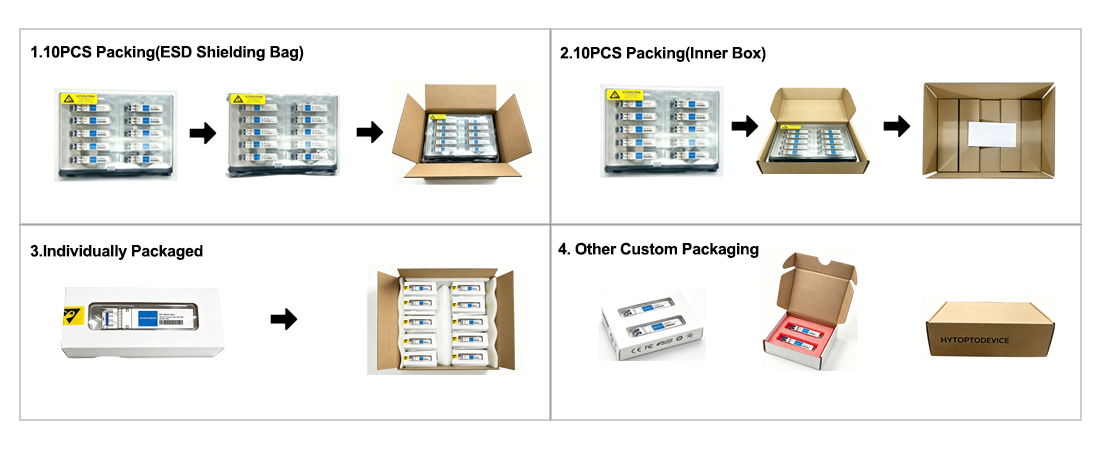
ESD Protection & Fast Shipping: Every module is sealed in an ESD-safe bag and ready for same-day dispatch from stock.
Custom OEM & Branding: We provide logo printing, private labeling, and custom packaging to help distributors and integrators build their brand—no factory investment required.
Why Network Engineers Choose HYTOPTODEVICE
HYTOPTODEVICE has supplied over 5000,000 optical transceiver modules to data centers, ISPs, and enterprise networks across 100+ countries since 2011. Every module undergoes a 72-hour burn-in test and full DDM/DOM validation before shipment.
“Phenomenal performance. We deployed 200 HYTOPTODEVICE SFP modules to replace Cisco OEMs in our backbone network. Result? Zero compatibility issues and a 60% reduction in costs. Highly recommended for mission-critical networks."— Senior Network Engineer, Regional Telecom, Australia
Quality Certification & Compliance
At HYTOPTODEVICE, our quality commitment is backed by industry-standard validations. From fiber optical transceiver manufacturing to final visual inspection, from IQC、IPQC、FQC to OQC, our processes ensure global compliance and reliability.
We adhere to rigorous standards for our SFP modules and network solutions:
ISO 9001: Certified quality management and production consistency.
CE & FCC: Fully compliant for seamless Global Market Access.
RoHS: Committed to environmental responsibility and hazardous material control.
Proven Reliability: Rigorous testing to reduce compliance risk and ensure safety.
Certified Quality. Global Standards. Guaranteed Performance.







