| NO. | Brand | Compatible P/N | Transceiver Type |
| 1 | Cisco | QSFP-200G-SR4-S | QSFP56-200G-FR4 |
| 2 | Arista | QSFP-200G-SR4 | QSFP56-200G-LR4 |
| 3 | Dell | Q56-200G-SR4 | QSFP56-200G-ER4 |
| 4 | Huawei | QSFP56-200G-SR4 | |
| 5 | Ruijie Networks | 200G-Q56-SR4-MM850 | |
| 6 | NVIDIA/Mellanox | MMA1T00-VS | |
| 7 | H3C | QSFP56-200G-SR4-MM850 |
H3C Compatible |
QSFP56-200G-SR4-MM850 | Vendor Name | HYTOPTODEVICE |
| Form Factor | QSFP56 | Max Data Rate | 200Gbps (4x50Gbps) |
| Wavelength | 850nm
|
Max Distance | 70m on OM3/100m on OM4 |
| Modulation Format | PAM4 | Host Required | FEC |
| Connector | MPO-12(UPC) | Voltage Supply | 3.3V |
| Cable Type | MMF | Receiver Overload | 4dBm |
| Transmitter Type | VCSEL 850nm | Receiver Type | PIN |
| TX Power | -6.5~+4.0dBm | Receiver Sensitivity | < -8.4dBm |
| Operation Temperature | 0 to 70°C (32 to 158°F) | Maximum Power | < 4.5W |
| Protocols | QSFP56 MSA, IEEE 802.3bs | Application | 200G Ethernet, High performance computing, Data Center Interconnect |
Usage Guidelines & Best Practices
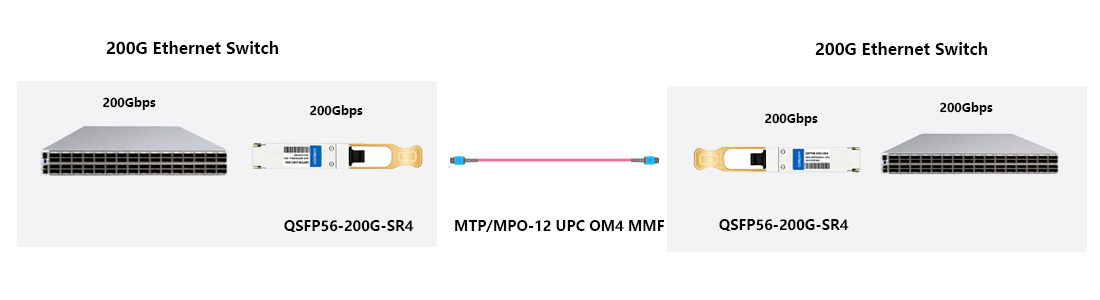
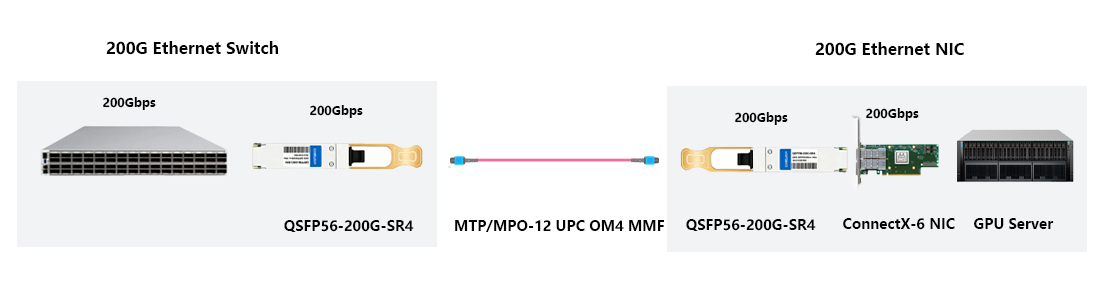
Fiber Choice: Only works with OM3 / OM4 multi‑mode MPO‑12 trunk cable; single‑mode fiber cannot support 850nm SR4 transmission and will lead to link failure.
Distance Limit: Max 70m on OM3 MMF, max 100m on OM4 MMF; excessive splices, dirty end‑faces or sharp bends reduce actual working distance.
Cleanliness & Dust: Keep dust caps on whenever unattached. Clean fiber end-faces with a optical cleaning pen before insertion; dust causes over 80% of optical link failures.
Installation Specification: Hot‑plug supported; keep MPO connector end‑faces clean, observe minimum fiber‑bend radius requirements.
Operating Environment: Commercial temperature range 0°C‑70°C; maintain cabinet airflow to avoid module overheating.
For detailed operation instructions, please refer to the User Guide.
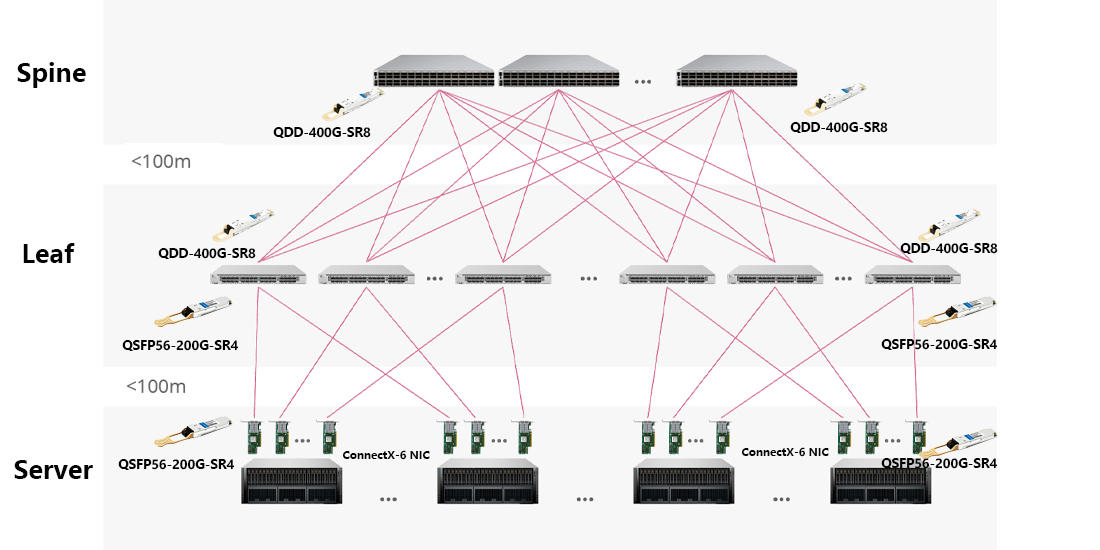
Built on universal MSA open standards, this QSFP56 transceiver is interoperable with mainstream network brands including Arista, Juniper, H3C, Huawei and Fortinet, adapting to mixed‑vendor leaf‑spine network upgrade and expansion scenarios.
• Leaf‑spine fabric deployments for modern AI‑ready data‑center architectures
• High‑density rack‑to‑rack trunk interconnections
• 200G high‑speed server and storage uplink connections
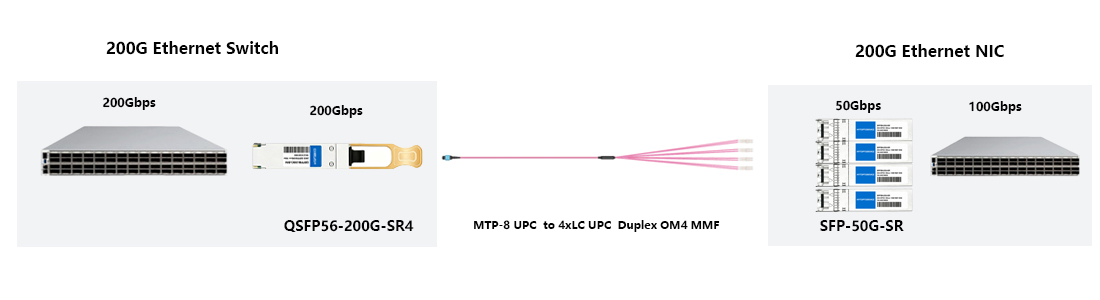
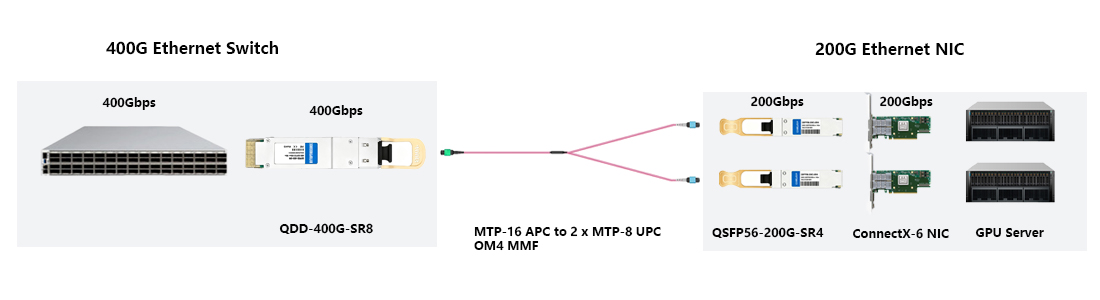
• 200G to 2×100G / 4×50G breakout architecture (host‑firmware dependent)
• Cost‑effective H3C data‑center network hardware upgrade projects
• Inventory supply for global distributors and system integrators for data‑center tender projects


Q1: Can our existing fiber maintenance toolkit and MPO patch cords support 200G migration, or must we invest in brand-new cabling assets?
A: Yes, existing OM3/OM4 MPO-12 patch cords and standard fiber cleaning kits remain usable. As a trusted manufacturer, HYTOPTODEVICE designs this QSFP56 200G SR4 transceiver with standard MPO-12/UPC interface to help wholesale buyers reuse current cabling assets and cut upgrade expenditure.
Q2: Will third-party QSFP56 200G SR4 optics trigger alert logs or port blocking when deployed inside H3C and multi-vendor switch fabrics?
A: Alert behavior depends on vendor transceiver lock mechanisms. Our factory HYTOPTODEVICE supports customized EEPROM coding to match required vendor signatures, reducing warning alarms on H3C and other mainstream platforms; we recommend bulk purchasers confirm switch OS limitations before ordering.
Q3: Can inconsistent FEC parameters between mixed-brand network hardware and optics create unexpected link outages in our fabric?
A: Yes, mismatched FEC settings can cause intermittent link flapping. HYTOPTODEVICE, as an experienced supplier, supplies clear FEC configuration guides for multi-vendor deployments; our pre-validated QSFP56 200G SR4 optics run reliably once uniform host-side PAM4 FEC is activated.
Q4: What is the certified transmission range of QSFP56 200G SR4, and can it run stably over legacy OM3 multimode cabling?
A: The maximum working distance is 70 meters over OM3 multimode fiber and 100 meters over OM4 multimode fiber. This HYTOPTODEVICE QSFP56 200G SR4 transceiver fully supports legacy OM3 cabling, helping buyers preserve their existing structured cabling investment.
Q5: Will deploying dense banks of 200G transceivers push our ToR switches beyond safe thermal thresholds during full-load operation?
A: It will not create thermal bottlenecks with proper airflow planning. This HYTOPTODEVICE QSFP56 200G SR4 module adopts low-power design below 5W; high-density deployments only require standard rack airflow management to avoid thermal throttling.
Q6: Does PAM4 encoding and FEC processing on 200G SR4 introduce perceptible latency for low-latency HPC and trading clusters?
A: No, latency overhead introduced by PAM4 and RS-FEC stays at sub-microsecond levels. Pre-tested optics from our manufacturer HYTOPTODEVICE are suitable for HPC and latency-sensitive AI workloads requiring consistent forwarding performance.
Q7: How vulnerable are the internal optical arrays inside SR4 transceivers against airborne contamination inside data center racks?
A: The built-in VCSEL and receiver arrays are sensitive to dust contamination. Dirty MPO end-faces raise insertion loss and trigger unstable links. HYTOPTODEVICE supplies dust caps on every module and reminds operators of routine connector cleaning protocols.
Q8: What after-sales support can we expect from the supplier if DOA units appear within a bulk shipment of QSFP56 200G SR4 modules?
A: HYTOPTODEVICE offers direct DOA replacement service for confirmed faulty units. Every batch leaves our factory after full optical and electrical aging testing, and wholesale customers get dedicated engineering support to settle DOA issues quickly.
Q9: Are performance variances common across transceiver batches sourced from the same optical module factory?
A: No, batch-to-batch performance consistency is strictly controlled. HYTOPTODEVICE, as a professional manufacturer, applies unified optical specs and standardized test workflows across all QSFP56 200G SR4 production runs to maintain uniform fabric performance.
Q10: When troubleshooting a downed 200G link, will our optics supplier provide collaborative diagnosis or simply shift responsibility to the switch maker?
A: HYTOPTODEVICE delivers cooperative end-to-end troubleshooting support instead of one-sided blame. Our engineering team reviews DOM logs, optical parameters and interoperability conditions together with procurement customers to isolate root causes.
Q11: Is speed downgrade available on a 200G SR4 port during phased network migration projects?
A: No, 200GBASE-SR4 does not support auto-negotiation down to lower speeds. This HYTOPTODEVICE QSFP56 200G SR4 transceiver only operates at native 200G speed, so phased rollouts require careful port speed planning.
Q12: Are the optical power and temperature DOM readings output by these QSFP56 transceivers reliable for continuous infrastructure monitoring?
A: Yes, DOM telemetry data is trustworthy for daily link health monitoring. Each HYTOPTODEVICE QSFP56 200G SR4 module is factory-calibrated, and CMIS DDM outputs deliver stable, accurate real-time metrics for data center O&M teams.
Q13: Do our field engineers require specialized certification to safely install and manage MPO-based multimode transceivers?
A: Basic fiber handling training is sufficient; advanced certification is not mandatory. As your reliable supplier, HYTOPTODEVICE ships MPO polarity guides and operation notes alongside orders to help technicians deploy these QSFP56 200G SR4 modules correctly.
Q14: How much risk of permanent damage does ESD exposure bring to QSFP56 optics during routine rack maintenance?
A: QSFP56 transceivers are ESD-sensitive electronic components; static discharge can permanently damage VCSEL chips. HYTOPTODEVICE packs all modules inside anti-static packaging and reminds maintenance teams to wear ESD wrist straps.
Q15: How can bulk procurement of these 200G SR4 optics help our organization meet official ESG reporting requirements?
A: These QSFP56 200G SR4 modules satisfy RoHS restricted substance compliance. HYTOPTODEVICE, as a responsible manufacturer, uses low-power optical design and optimized production workflows to help wholesale buyers achieve green IT and ESG data center targets.
Packaging & Custom OEM Solutions
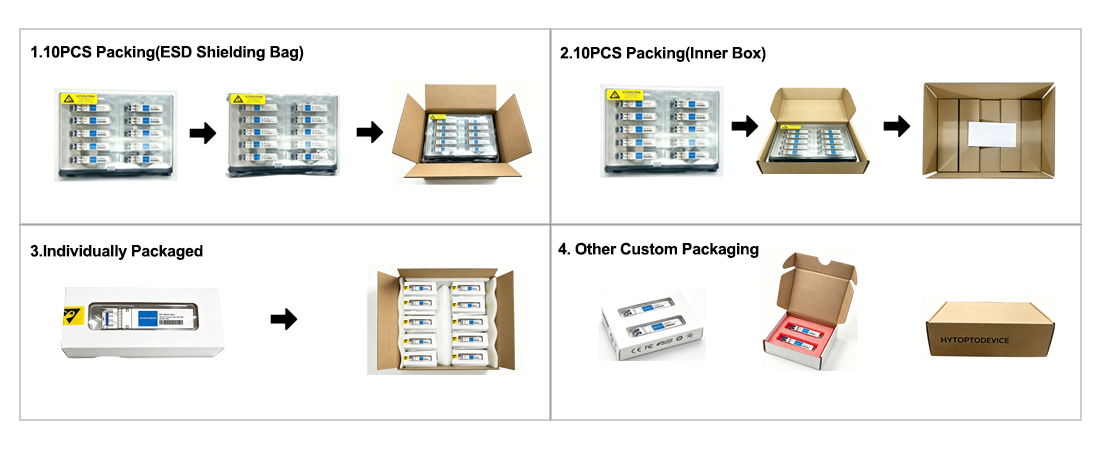
ESD Protection & Fast Shipping: Every module is sealed in an ESD-safe bag and ready for same-day dispatch from stock.
Custom OEM & Branding: We provide logo printing, private labeling, and custom packaging to help distributors and integrators build their brand—no factory investment required.
Why Network Engineers Choose HYTOPTODEVICE
HYTOPTODEVICE has supplied over 5000,000 optical transceiver modules to data centers, ISPs, and enterprise networks across 100+ countries since 2011. Every module undergoes a 72-hour burn-in test and full DDM/DOM validation before shipment.
“Phenomenal performance. We deployed 200 HYTOPTODEVICE SFP modules to replace Cisco OEMs in our backbone network. Result? Zero compatibility issues and a 60% reduction in costs. Highly recommended for mission-critical networks."— Senior Network Engineer, Regional Telecom, Australia
Quality Certification & Compliance
At HYTOPTODEVICE, our quality commitment is backed by industry-standard validations. From fiber optical transceiver manufacturing to final visual inspection, from IQC、IPQC、FQC to OQC, our processes ensure global compliance and reliability.
We adhere to rigorous standards for our SFP modules and network solutions:
ISO 9001: Certified quality management and production consistency.
CE & FCC: Fully compliant for seamless Global Market Access.
RoHS: Committed to environmental responsibility and hazardous material control.
Proven Reliability: Rigorous testing to reduce compliance risk and ensure safety.
Certified Quality. Global Standards. Guaranteed Performance.