Q1: What link failure risks appear while retrofitting legacy dual-fiber infrastructure with 10G BiDi SFP Transceiver 60km for Dell enterprise network upgrades?
A: Legacy dual-fiber networks separate transmit and receive signals over two independent fiber strands, while 10G BiDi SFP Transceiver 60km consolidates upstream and downstream traffic onto a single fiber core. Improper mixing of BiDi optics and old dual-fiber cabling during Dell network migration results in unestablishable links, alongside messy fiber patching and project scheduling delays. HYTOPTODEVICE delivers free pre-upgrade network layout consulting for Dell GP-SFP-10GBX-U-60 compatible modules, standardizing BiDi transformation workflows to avoid legacy architecture conflicts.
Q2: Why do ODF port labeling mistakes surge during large-scale 10G BiDi SFP Transceiver 60km Dell single-fiber rollouts?
A: Field technicians are trained around dual-fiber TX/RX paired labeling rules, yet 10G BiDi SFP Transceiver 60km only requires one fiber per full-duplex link. Staff hunting for the non-existent second strand frequently pull out active adjacent circuits, triggering mass ODF labeling confusion and accidental live service outages. HYTOPTODEVICE supplies dedicated BiDi marking templates for Dell long-haul projects to unify on-site fiber identification and cut human error.
Q3: Why are APD receivers inside generic 10G BiDi SFP Transceiver 60km prone to permanent burnout during Dell on-site deployment?
A: To hit the 60km transmission threshold, standard 10G BiDi SFP Transceiver 60km uses high-sensitivity APD receivers instead of common PIN chips. APD hardware carries an ultra-low optical overload threshold ranging from -6dBm to -8dBm, which easily gets damaged by unintended strong light exposure during plug-and-test operations. Our HYTOPTODEVICE Dell replacement 10G BiDi SFP Transceiver 60km integrates built-in anti-overlight protection circuits to extend receiver lifespan and improve field construction safety.
Q4: How does natural DFB laser aging degrade long-term stability of 10G BiDi SFP Transceiver 60km Dell metro backbone links?
A: All 60km single-fiber links operate right at the edge of optical power budget limits. Even a tiny 0.5dB transmit power drop from years of laser aging on generic 10G BiDi SFP Transceiver 60km generates heavy CRC bursts and random intermittent packet loss, creating long-term hidden operation hazards for Dell WAN infrastructure. HYTOPTODEVICE equips our Dell-compatible BiDi modules with low-attenuation industrial-grade DFB lasers to slow aging drift and sustain steady multi-year transmission performance.
Q5: Why can’t standard VFL red light testers accurately locate faults on 10G BiDi SFP Transceiver 60km long-distance Dell fiber routes?
A: Basic visual fault locators merely verify fiber continuity and cannot overcome extreme signal attenuation and heavy connector back-reflection across 60km fiber spans deployed with 10G BiDi SFP Transceiver 60km. Field teams have to rely on costly OTDR equipment for full troubleshooting, raising maintenance expenses for Dell single-fiber networks. HYTOPTODEVICE shares exclusive BiDi fault inspection guides to boost technicians’ diagnostic efficiency for 60km long-reach links.
Q6: How does connector back-reflection hurt OSNR performance of 10G BiDi SFP Transceiver 60km Dell single-fiber backbone links?
A: Dual-fiber transceivers isolate transmit and receive optical paths to block reflected interference, while 10G BiDi SFP Transceiver 60km shares one integrated optical assembly for both directions. Micro scratches or dust on simplex LC connectors bounce light straight back into the internal receiver, severely lowering optical signal-to-noise ratio and destabilizing long-haul Dell network transmission. HYTOPTODEVICE adds high-isolation internal WDM filters to its Dell GP-SFP-10GBX-U-60 compatible modules to suppress back-reflection noise.
Q7: How does PMD distortion create hard-to-trace intermittent packet loss over legacy fiber with 10G BiDi SFP Transceiver 60km on Dell switches?
A: Outdated aging G.652 fiber produces severe Polarization Mode Dispersion, which stretches optical pulse signals sent by 10G BiDi SFP Transceiver 60km across 60km spans. This leads to unpredictable, non-repeating random packet drops that rank among the most elusive intermittent faults for Dell metro network operation teams. HYTOPTODEVICE adopts optimized laser pulse shaping algorithms to mitigate PMD interference and reduce invisible error bursts on old fiber renovation projects.
Q8: What failures occur from mismatching industrial and commercial temperature grade 10G BiDi SFP Transceiver 60km on Dell outdoor networking hardware?
A: Unattended roadside Dell cabinets demand industrial-grade transceivers rated -40°C to 85°C. Installing cost-cut commercial-grade 10G BiDi SFP Transceiver 60km (0°C to 70°C) in outdoor environments triggers frequent module restarts, signal blackouts or irreversible chip damage under extreme hot and cold weather. HYTOPTODEVICE provides full industrial temperature range Dell-compatible 10G BiDi SFP Transceiver 60km to deliver consistent stable operation in harsh outdoor field conditions.
Q9: Why do generic 10G BiDi SFP Transceiver 60km trigger SFP+ MSA compliance failures on Dell enterprise switching platforms?
A: Original SFP+ MSA specifications were not developed around single-fiber bidirectional transmission. Many off-brand 10G BiDi SFP Transceiver 60km alter I2C clock timing, Rate Select and TX_Disable pin logic outside standard MSA limits, resulting in port lockups and recognition errors when running on Dell switches. Every HYTOPTODEVICE Dell GP-SFP-10GBX-U-60 compatible 10G BiDi SFP Transceiver 60km strictly follows unified SFP+ MSA standards to eliminate abnormal hardware compatibility issues.
Q10: Why do standard optical power testers deliver misleading readings while maintaining 10G BiDi SFP Transceiver 60km Dell long-haul links?
A: 10G BiDi SFP Transceiver 60km relies on alternating 1270nm and 1330nm bidirectional wavelengths, requiring manual wavelength switching on optical power meters during testing. Field technicians frequently skip adjusting the wavelength mode, generating multi-dB measurement deviations that lead to wrong fault judgments and unnecessary rework on Dell single-fiber infrastructure. HYTOPTODEVICE distributes standardized wavelength testing SOPs to guarantee precise field optical power detection.
Q11: What sudden total outages stem from the cliff-style aging lifecycle of regular 10G BiDi SFP Transceiver 60km on Dell long-distance single-fiber links?
A: After 3 to 5 years of continuous operation, laser drive current and APD bias voltage inside generic 10G BiDi SFP Transceiver 60km suffer severe drift. Instead of slow, predictable performance degradation, these long-reach BiDi optics suffer abrupt total failure without early warning signals, disrupting Dell enterprise business traffic instantly. HYTOPTODEVICE calibrates stable voltage and current control circuits for its Dell-compatible modules, delivering gradual performance decline and early DDM fault alerts to avoid unplanned sudden link downtime.
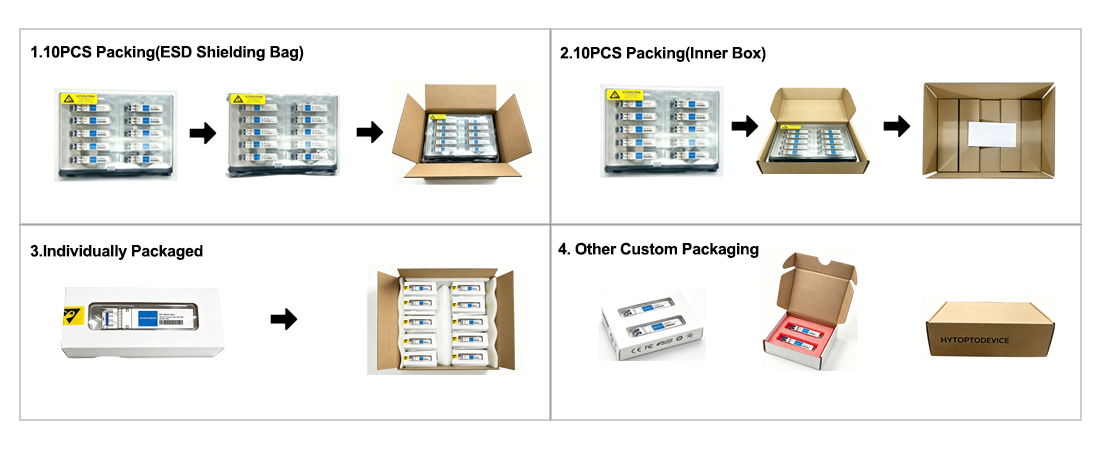
Packaging & Custom OEM Solutions
Each module ships individually sealed in ESD-safe packaging, protected from static from our warehouse to your shelf—and ready to ship on receipt of order. Volume buyers and system integrators also unlock our full OEM program: custom logos, private labeling, and branded packaging, all designed to help you build and protect your own brand.