
The optical networking hardware market hit $23 billion in 2025 and is tracking toward $26 billion in 2026, with year-over-year growth at 57% driven by AI infrastructure buildouts and 5G telecom expansion. That pace of growth means procurement teams are under pressure to scale capacity fast while controlling costs — and OEM transceiver pricing at $200 to $500 or more per unit makes that math difficult at scale.
HYTOPTODEVICE was built for exactly this environment. As a global e-commerce supplier of optical transceivers and networking hardware, HYTOPTODEVICE covers 1.25G to 800G across every major form factor, with compatibility verified against Cisco, Huawei, Arista Networks, and Juniper platforms. Here's what HYTOPTODEVICE offers, who it serves, and why network engineers and procurement leads are choosing it as a cost-effective optical module source.
The core issue is price, not performance. OEM modules from Cisco, Juniper, Huawei, and Arista carry a significant markup that reflects brand licensing, not manufacturing cost. Third-party compatible modules from qualified suppliers deliver 70 to 90 percent cost savings against those OEM price points.
For a data center deploying 400G or 800G at scale, that difference is material. A 500-unit deployment using OEM 400G QSFP-DD modules at $400 each runs $200,000. The same deployment using compatible alternatives at $100 to $200 per unit drops that to $50,000 to $100,000.
The hesitation has always been compatibility. Network engineers worry about modules that trigger vendor lock-in warnings, fail DOM readings, or cause link instability. That concern is valid when buying from unverified sources — it's not valid when the supplier publishes compatibility test videos and datasheets for each product, as HYTOPTODEVICE does at hytoptodevice.com.
Data center interconnect demands high-density, high-speed optics at predictable cost. HYTOPTODEVICE stocks the full range of data center optical transceiver form factors: QSFP28 for 100G, QSFP56 for 200G, QSFP-DD and OSFP for 400G and 800G. Specific stocked products include the Cisco-compatible 200G QSFP56 SR4 and the Arista-compatible 800G QSFP-DD DR8.
For short-range rack and row interconnects, the catalog includes Direct Attach Cables and Active Optical Cables — including a 100G QSFP28 to 4x25G SFP28 breakout DAC at 5 meters. These cover spine-leaf and top-of-rack deployments without requiring active optics where passive copper works.
AI GPU clusters running NVLink or InfiniBand fabrics need high-speed interconnect with minimal latency and high port density. The AI server optical module segment is one of the fastest-growing categories in the market, directly tied to the 57% YoY growth projection for 2026. HYTOPTODEVICE's 400G QSFP-DD and 800G QSFP-DD DR8 modules address this directly, supporting the high-bandwidth, low-latency links that GPU-to-GPU communication requires.
5G fronthaul and backhaul deployments rely heavily on CWDM and DWDM optics for fiber-efficient, long-reach transmission. HYTOPTODEVICE carries CWDM and DWDM variants at reach distances from 10KM to 120KM, with at least one DWDM SFP module rated to 160KM — covering both urban small-cell fronthaul (typically 10KM to 20KM) and regional backhaul links that require extended reach.
5G telecom transmission infrastructure also demands protocol flexibility. HYTOPTODEVICE modules support Fibre Channel, SONET/SDH, and OTN, making them compatible with carrier-grade transport platforms beyond Ethernet-only data center environments.
Cloud providers and colocation facilities running hyperscale or near-hyperscale workloads need optics that scale without proportional cost increases. The cloud computing optics challenge is volume: deploying thousands of modules per quarter makes per-unit pricing the dominant variable in total infrastructure cost.
HYTOPTODEVICE's catalog breadth — from SFP at 1.25G through OSFP at 800G — means procurement teams can source across multiple speed tiers from a single supplier. That simplifies vendor management and reduces the overhead of qualifying separate sources for different form factors.
Enterprise networks typically run a mix of 1G, 10G, and 25G at the access and distribution layers, with 40G, 100G, or 400G at the core. HYTOPTODEVICE covers this full stack: SFP for 1.25G, SFP+ for 10G, QSFP+ for 40G, and QSFP28 for 100G, all with compatibility across the major enterprise network switch transceiver platforms.
For IT teams managing Cisco Catalyst, Arista EOS, Juniper EX, or Huawei CloudEngine switches, the compatibility question is answered by on-site test videos and datasheets — not just vendor claims.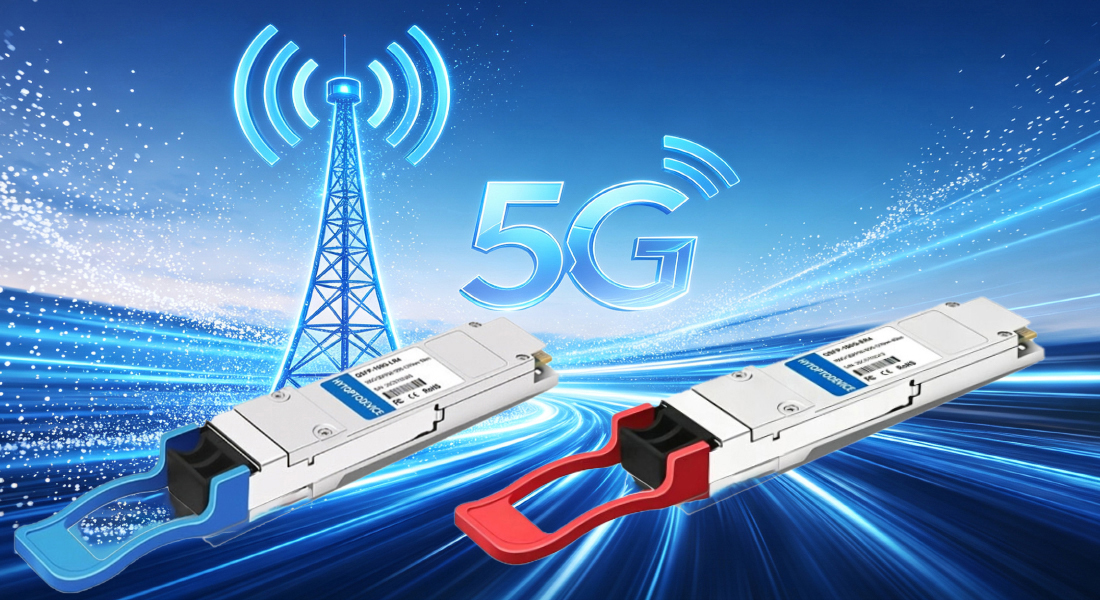
The catalog at HYTOPTODEVICE is built around complete form factor coverage, not a curated subset of popular SKUs.
Form factors stocked:
Reach and wavelength coverage:
Interconnect cables:
Switching hardware:
This is the high-speed interconnect coverage range that network engineers need when sourcing for mixed-generation environments — not just greenfield 400G deployments.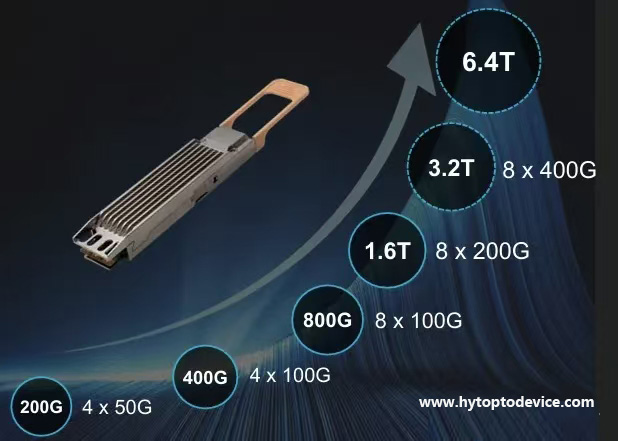
Compatibility is where many third-party suppliers fall short. HYTOPTODEVICE takes a different approach: every module is tested and verified against the platforms it claims to support, with compatibility test videos published on-site.
The claim is specific — 100% compatible with Cisco, Huawei, Arista, and Juniper platforms. That covers the four vendors that dominate enterprise and carrier deployments globally.
For Cisco environments, this includes Catalyst, Nexus, and ASR platforms. For Arista, EOS-based switches including the 7000 series. For Juniper, QFX and MX series. For Huawei, CloudEngine data center switches and NE series routers.
The compatibility test videos at hytoptodevice.com show live insertion and link-up tests, DOM readout verification, and platform recognition. For technical buyers who need proof before committing to a bulk order, this is the validation step that replaces a full lab evaluation.
HYTOPTODEVICE is not only a catalog supplier. Its OEM alternative supplier capability covers custom-programmed modules, white-label production, and application-specific optics for businesses that need branded or purpose-built transceivers.Private Label support - EEPROM / firmware customization support.
The mid-market OEM gap is real. Traditional OEMs set minimum order quantities that price out most mid-size buyers. HYTOPTODEVICE supports runs in the 100 to 1,000 unit range with faster turnaround than a traditional OEM engagement — making custom optics accessible to ISPs, resellers, and enterprise IT teams that previously had no practical path to branded modules.
ODM services extend this further. If your application requires a specific wavelength, reach, or form factor not covered by standard catalog SKUs, HYTOPTODEVICE can engineer it. BOSA sub-assemblies at custom wavelengths from 1310nm to 1550nm, covering 3KM to 80KM, are already in the catalog as a working example of that capability.
For reseller partners, white-label programs let you sell under your own brand without building a manufacturing operation. The framing is straightforward: your brand, our engineering.
The optical transceiver alternative market has matured significantly. The question is no longer whether compatible modules work — it's which supplier has the catalog depth, compatibility verification, and OEM capability to serve as a long-term supply partner.
HYTOPTODEVICE addresses each of those dimensions:
For network engineers, data center procurement managers, ISP buyers, and telecom operators, HYTOPTODEVICE offers a technically credible, cost-effective optical module source across every speed tier your infrastructure currently runs — or will run next.
Explore the full catalog at hytoptodevice.com.
A1:Yes. HYTOPTODEVICE modules are 100% compatible with Cisco, Huawei, Arista, and Juniper platforms. Compatibility test videos and datasheets are published on-site at hytoptodevice.com, showing live insertion tests, DOM verification, and platform recognition across all four vendors.
A2:The catalog spans 1.25G to 800G across SFP, SFP+, XFP, QSFP+, QSFP28, QSFP56, QSFP-DD, and OSFP form factors — covering access-layer, enterprise core, data center, AI server, and carrier applications from a single supplier.
A3:Third-party compatible modules in this category typically deliver 70 to 90 percent cost savings versus OEM modules priced at $200 to $500 or more per unit. The exact figure depends on the specific module and OEM list price, but the gap is significant at any deployment scale.
A4:Yes. HYTOPTODEVICE supports OEM and ODM production including custom-programmed modules, white-label manufacturing, and application-specific optics. The service is designed for mid-market buyers needing 100 to 1,000 unit runs with faster turnaround than traditional OEM suppliers offer.
A5:HYTOPTODEVICE stocks CWDM and DWDM variants at reach distances from 10KM to 120KM, with at least one DWDM SFP module rated to 160KM. This covers 5G fronthaul, regional backhaul, and metro and long-haul carrier links.
Reference Sources
1.100 Gigabit Ethernet
2.QSFP-DD MSA
3.100G QSFP28
4.200G QSFP56
5.400G QSFP-DD
6.100G QSFP28 to 4x25G SFP28 DAC
7.How to migrate and upgrade from 100G to 400G?
8.1.6T Optical Modules: The Mass Production Roadmap from 800G to 1.6T Evolution


