
An optical transceiver is a pluggable module that converts electrical signals to optical for transmission over fiber, then converts them back to electrical at the far end. Both directions happen inside a single housing you slot into a switch, router, or line card.see the transmit/receive theory chart: 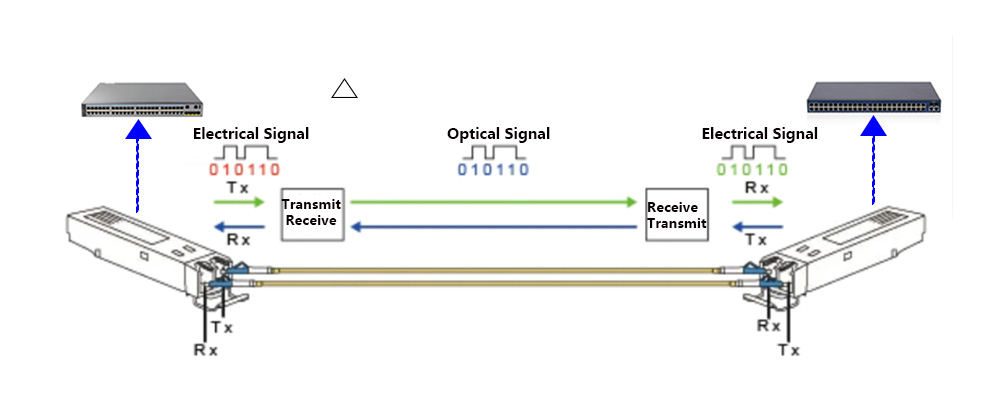
The electro-optical framing is accurate: every transceiver has a transmitter side (electrical in, optical out) and a receiver side (optical in, electrical out). The laser diode, photodetector, driver circuitry, and digital diagnostics all live inside that small cage. Understanding that architecture helps you spec the right module for your link budget, reach requirement, and host platform.see the structure chart of optical transceiver: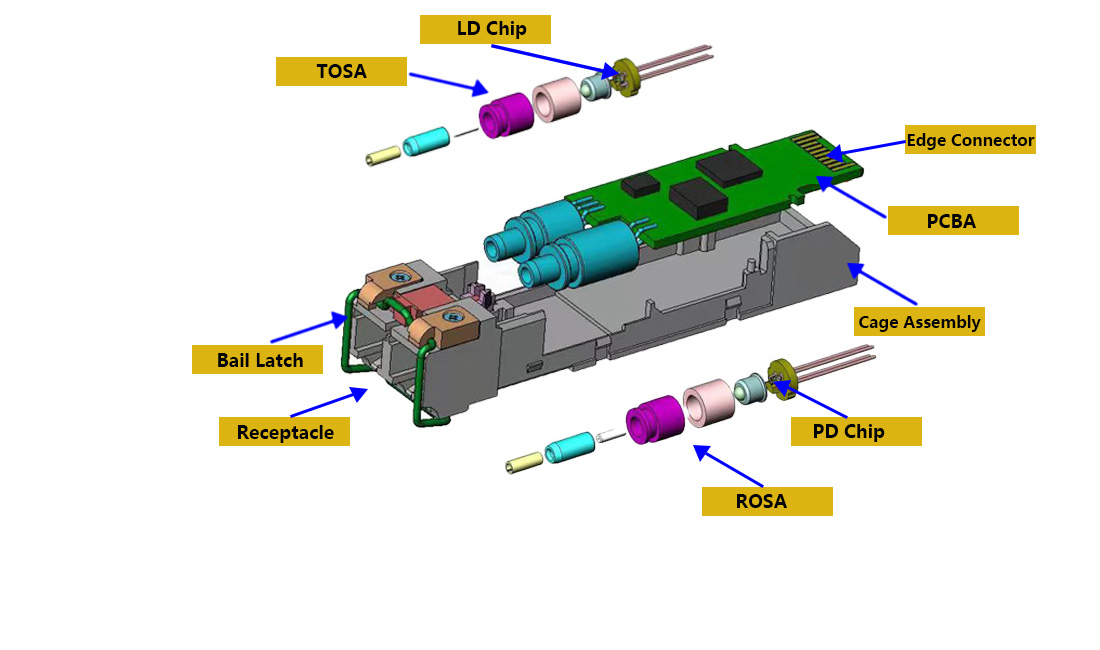
The optical networking hardware market sits at roughly $23 billion in 2026, driven by AI/ML cluster buildouts, 5G transport deployments, and data center modernization. Transceivers are at the center of all three.
An electro-optical system is any device that converts between electrical and optical domains. In networking, the transceiver's laser driver converts a digital electrical signal into a modulated optical output, while the transimpedance amplifier (TIA) on the receive side converts incoming photocurrent back into a usable electrical signal.
At higher speeds, the modulation scheme gets more complex. A 100G QSFP28 LR4 uses four 25G lanes across separate wavelengths. An 800G OSFP may run 8×100G lanes with PAM4 modulation, where each lane carries two bits per symbol to double spectral efficiency without doubling the symbol rate.
The practical implication: when you source a transceiver, you're specifying a complete electro-optical subsystem with defined transmit power, receive sensitivity, extinction ratio, and eye mask compliance. Those parameters determine whether your link holds at the designed reach distance or fails intermittently under load.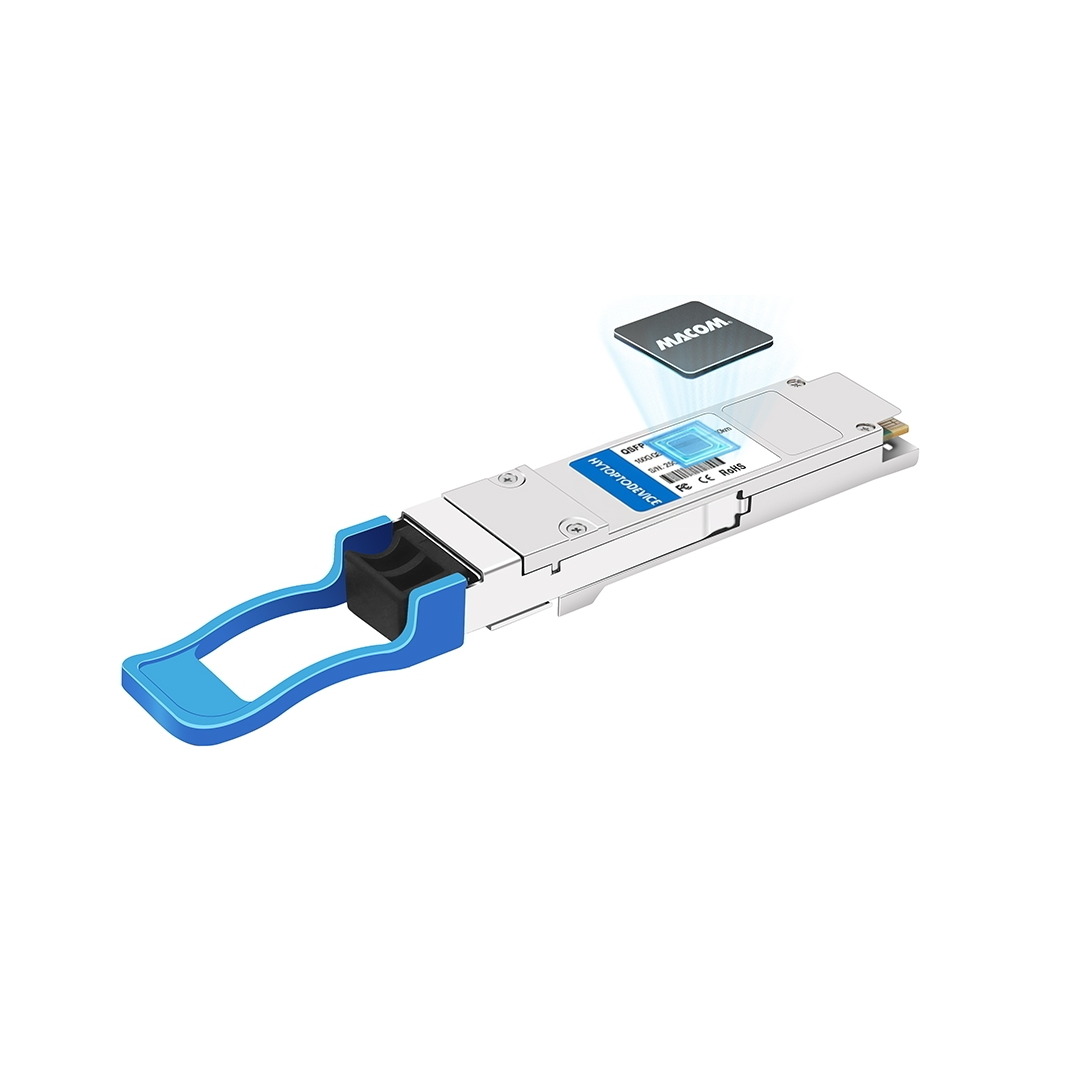
Form factor determines physical compatibility with your switch or router cage. Here's how the major formats map to speed in 2026:
| Form Factor | Typical Speed | Common Use Case |
|---|---|---|
| SFP | 1.25G | Access layer, legacy ISP links |
| SFP+ | 10G | Enterprise aggregation, storage |
| SFP28 | 25G | Server-to-ToR connections |
| XFP | 10G | Older DWDM line cards |
| QSFP+ | 40G | Data center spine, older fabric |
| QSFP28 | 100G | Hyperscale spine, ISP peering |
| QSFP56 | 200G | High-density data center fabric |
| QSFP-DD | 400G | AI/ML cluster interconnect |
| OSFP | 400G / 800G | Next-gen hyperscale and 5G core |
QSFP-DD and OSFP both target 400G and above, but they use different cage designs. QSFP-DD is backward compatible with QSFP28 cages on some platforms; OSFP is not. Verify your switch's cage spec before ordering.
The optical transceiver catalog at HYTOPTODEVICE covers all eight form factors from 1.25G SFP through 800G OSFP in a single storefront — which matters when you're sourcing across multiple tiers of a network refresh at the same time.
Both CWDM and DWDM carry multiple signals over a single fiber pair using wavelength-division multiplexing, but they differ in channel spacing, cost, and capacity.
CWDM uses 20nm channel spacing across 18 wavelengths from 1270nm to 1610nm. The wider spacing allows simpler, uncooled lasers and lower module cost. It works well for metro and regional deployments where you need 4 to 18 channels over distances up to 80KM without optical amplification.
DWDM uses 0.8nm (100GHz) or 0.4nm (50GHz) channel spacing, supporting 40 to 96 channels per fiber pair. The tight spacing requires temperature-controlled lasers, which raises module cost but enables long-haul transmission from 80KM to 120KM and beyond — especially when paired with EDFA amplification.
For ISP backbone and carrier transport, DWDM at 80KM to 120KM is the standard. For enterprise campus and metro aggregation where you need a handful of channels at moderate reach, CWDM is typically the more cost-effective path.
Reach is determined by transmit power, fiber loss, and receiver sensitivity. Every transceiver datasheet specifies a maximum reach at a defined fiber type and loss budget. Push past that budget without optical amplification and you get bit errors and link instability.
Standard reach categories you'll encounter:
CWDM and DWDM modules extend these categories further. A 1.25G DWDM SFP rated to 120KM, for example, targets carrier access and long-haul ISP aggregation where every dB of link budget counts.
Most transceivers are protocol-agnostic at the optical layer, but the host interface and module firmware still need to match your platform's expectations.
Ethernet is the dominant protocol across data center, enterprise, and ISP applications. Speeds from 1GbE through 800GbE map directly to the form factors above.
Fibre Channel shares the SFP+ and QSFP28 form factors but runs FC-specific speeds — 4G, 8G, 16G, 32G — with different HBA requirements. If you're running FC SAN, confirm the module is coded for FC operation, not just Ethernet.
SONET/SDH is still active in legacy carrier networks. OC-3 (155M) and OC-48 (2.5G) links persist in some telco access and backhaul infrastructure, and SONET/SDH SFP modules handle those rates.
OTN (Optical Transport Network) wraps a digital layer around client signals for performance monitoring, fault management, and tandem connection monitoring. It's standard in carrier core networks and increasingly common in data center interconnect (DCI) applications.
Cisco prices branded transceivers at $200 to $500 or more per module. Third-party compatible modules in the same performance tier deliver 70 to 90 percent cost savings per unit.
The math compounds quickly. A 48-port 10G switch refresh using OEM SFP+ modules at $300 each runs $14,400 in optics alone. The same refresh with third-party compatible modules at $30 to $60 per unit costs $1,440 to $2,880 — a $12,000 difference on a single switch.
The compatibility concern is real but manageable. Most enterprise switches from Cisco, Juniper, and Huawei run a vendor ID check in firmware that can flag non-OEM modules. The fix is a module coded with the correct vendor ID for your platform. Verified third-party suppliers program modules to match host platform requirements and publish compatibility test results to back it up.
Before committing to a bulk order, check the compatibility test videos and download the datasheet. That due diligence takes 10 minutes and eliminates the main risk of third-party sourcing.
Not every link needs a discrete transceiver and a patch cable. For distances under 10m to 30m within a rack or between adjacent racks, Active Optical Cables (AOC) and Direct Attach Cables (DAC) are faster to deploy and lower in cost.
DAC uses a copper twinax cable with fixed SFP+, QSFP28, or QSFP-DD connectors on each end. Passive DAC works to about 5m; active DAC extends to 10m to 15m with signal conditioning built into the connector housing. No optics, no fiber, no SFP cage wear.
AOC uses a fiber cable with integrated transceiver modules on each end. It handles distances from 1m to 100m, weighs less than copper, and runs cooler. It's the standard choice for top-of-rack to end-of-row runs in high-density data center deployments.
Both types span the speed range from 10G SFP+ through 400G QSFP-DD, covering every tier of a modern data center fabric.
Compatibility validation is the step most procurement teams skip — and it's where third-party transceiver purchases go wrong.
A structured pre-purchase process looks like this:
HYTOPTODEVICE publishes compatibility test videos and product datasheets available for download before you commit to a purchase — so you can complete that validation without having to contact sales first.
Q1:What is the difference between an electro-optical system and a standard optical transceiver?
A1:An electro-optical system is the broader category: any device that converts between electrical and optical signals. An optical transceiver is a specific implementation designed for pluggable networking applications. Every optical transceiver is an electro-optical system, but the term also covers sensors, imaging systems, and industrial optical devices outside networking.
Q2:Which transceiver form factor should I use for a 100G data center spine link?
A2:QSFP28 is the standard choice for 100G spine links in 2026. It fits the same cage as QSFP+ with firmware support, supports SR4, LR4, and CWDM4 variants, and is widely available from both OEM and third-party suppliers. QSFP28 LR4 covers 10KM over SMF; SR4 covers 100m over OM4.
Q3:Can I use a third-party transceiver in a Cisco switch without voiding support?
A3:Cisco's support policy doesn't cover third-party optics, but using a compatible module doesn't void the switch hardware warranty. The practical risk is a firmware-level vendor ID check that flags the module. Modules programmed with the correct Cisco vendor ID string pass that check and operate normally. Verify the module is coded for your specific Cisco platform before ordering.
Q4:What reach distance do I need for a metropolitan ISP backbone link?
A4:Most metro ISP backbone links fall in the 40KM to 80KM range. A 10G DWDM SFP+ at 80KM covers the majority of metro deployments. For links beyond 80KM, a 1.25G or 10G DWDM module rated to 100KM or 120KM — combined with EDFA amplification where needed — handles long-haul ISP transport.
Q5:What is the advantage of OSFP over QSFP-DD at 400G?
A5:OSFP's larger form factor provides more thermal headroom, which matters for coherent 400G modules running at higher power. QSFP-DD offers backward cage compatibility with QSFP28 on some platforms. If your switch supports both, check the thermal spec of your specific 400G module and the port density you need before choosing a cage type.
Q6:When does an AOC make more sense than a DAC for rack interconnects?
A6:AOC is the better choice when you need distances beyond 10m, when weight and bend radius matter in high-density cabling, or when you need to minimize EMI between racks. DAC is simpler and lower cost for distances under 5m where copper twinax is sufficient. Both are available from 10G through 400G.
Q7:What is OEM/ODM customization and when do I need it?
A7:OEM customization means programming a module with a specific vendor ID, part number, or firmware to match a target host platform or reseller requirement. ODM goes further — producing modules under your brand with custom labeling and packaging. You need OEM/ODM when you're building a product that ships with optics included, when you're a reseller who needs white-label modules, or when your platform requires a specific programmed part number that isn't available off the shelf.
An optical transceiver is a complete electro-optical system in a pluggable form factor. Getting the spec right means matching form factor, speed, protocol, reach distance, and host platform compatibility before the order ships — not after.
The cost argument for third-party compatible modules is straightforward in 2026: 70 to 90 percent savings per unit versus OEM pricing, with compatibility risk managed through proper vendor ID programming and pre-purchase validation.
Whether you're refreshing a 10G enterprise access layer, building out a 400G AI cluster fabric, or extending ISP backbone links at 80KM to 120KM over DWDM, the catalog at HYTOPTODEVICE covers every form factor from 1.25G to 800G with CWDM and DWDM options at every standard reach distance.
Reference Source:
1.Optical Transceiver
2.Gigabit_Ethernet
3.10 Gigabit Ethernet
4.100 Gigabit Ethernet
5.CWDM
6.DWDM
7.Ethernet
8.Compatibility
9.SAN
10.Fibre Channel(FC)


