What Are SFP Modules Used For?
By Jeff
December 3rd, 2025
187 views
SFP (Small Form-factor Pluggable) modules are compact, hot-swappable transceivers used primarily in networking and telecommunications equipment. Their main purpose is to provide flexible and modular connectivity by converting electrical signals from a network device (like a switch ) into optical or electrical signals for transmission.HYTOPTODEVICE, a professional optical transceiver manufacturer, will will provide you with a detailed explanation of what optical module is used for?
Table of Contents
一、How Do Fiber Optical Modules Actually Work?
二、 Primary Use Cases & Applications
三、Key Advantages of Using SFP Modules
四、 Common Types of SFP Modules
一、How Do Fiber Optical Modules Actually Work?
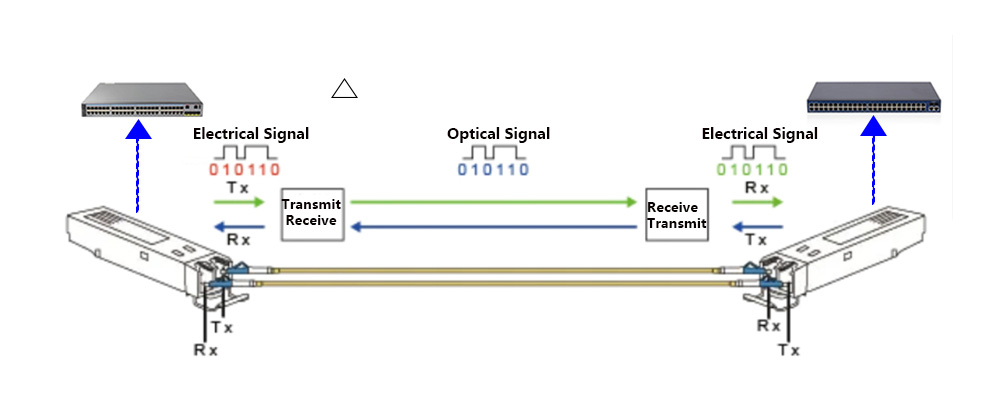
we've established what SFP and other optical transceivers do—they connect our networks over short and vast distances. But the real magic lies in how they accomplish this. At its core, an optical module is a sophisticated photonic translator, converting electrical signals into light and vice-versa with incredible speed and precision.
1.The Core Principle: Electro-Optical-Optical-Electrical (EOOE) Conversion
The entire operation can be summarized in four key steps, often called the EOOE loop:
(1)Electrical to Optical (E-O) Conversion (Transmit)
(2)Optical Transmission through fiber
(3) Optical to Electrical (O-E) Conversion (Receive)
(4)Signal Processing & Output
2. Let's break down what happens inside the fiber optical module to make this possible.
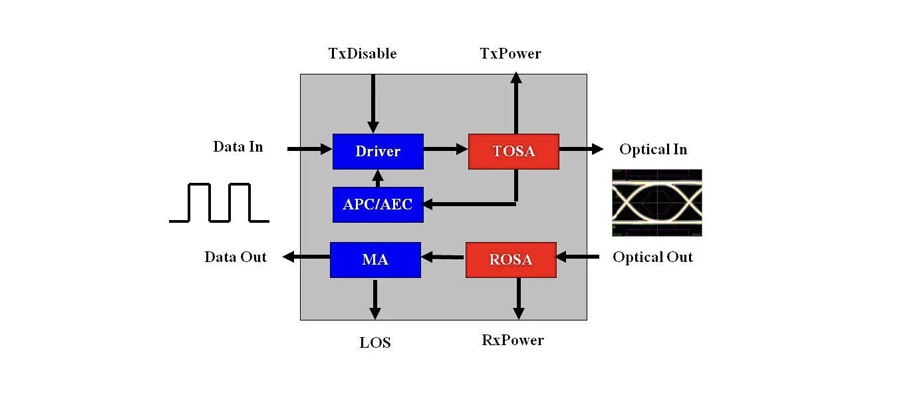
A typical optical transceiver houses two primary data paths (Tx for Transmit, Rx for Receive) and a control brain.
2.1 Transmit Path (Tx): Where Bits Become Light
(1) Electrical Interface: High-speed digital electrical signals (0s and 1s as voltage changes) arrive from the switch/router via the module's gold-plated edge connector.
(2)Laser Driver Chip: This chip acts as a precise current pump. It takes the weak incoming electrical signal and amplifies/modulates it into a strong, clean current stream tailored to drive the laser.
(3)The Laser (in TOSA): The heart of the transmitter. This is typically a TOSA (Transmitter Optical Sub-Assembly). It contains a microscopic semiconductor laser diode (like a VCSEL for short distances or a DFB laser for long-haul). When the modulated current from the driver hits it, the laser diode emits light pulses—a "1" is a pulse of light, a "0" is the absence of light.
(4) Optical Coupling: The generated light is focused and precisely coupled into the hair-thin core of the attached fiber optic cable. This alignment is micrometer-perfect.
2.2 Receive Path (Rx): Where Light Becomes Bits Again
(1) The Photodetector (in ROSA): Light pulses travelling through the fiber arrive at the receiver side. Here, a ROSA (Receiver Optical Sub-Assembly) contains a photodetector (usually a PIN or APD photodiode).
(2) O-E Conversion: This photodiode performs the reverse magic. When photons (light particles) strike its semiconductor material, they generate a tiny proportional electrical current.
(3)Trans-Impedance Amplifier (TIA): The generated current is extremely weak. The TIA is a highly sensitive amplifier that converts this tiny current into a usable voltage signal.
(4) Post-Amplifier & Decision Circuit: This stage amplifies the voltage signal further and cleans it up. A critical component called a limiting amplifier or clock/data recovery circuit determines whether each incoming pulse is a "1" or a "0," reconstructing the original digital electrical signal.
2.3 The Brain: The Controller Chip
Overseeing everything is a microcontroller(MCU). It:
· Manages communication with the host device via the I2C interface (the serial ID memory).
· Monitors real-time parameters: laser bias current, transmit power, receive power, temperature.
· Provides Digital Diagnostic Monitoring (DDM) data, enabling network managers to monitor the health of each link.
· Implements safety features, like shutting down the laser if a fault is detected.
二、 Primary Use Cases & Applications
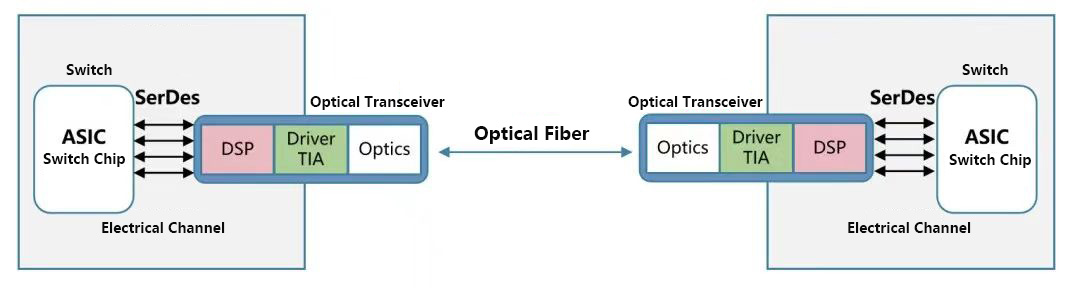
(1) Connecting Network Switches: This is the most common use. You can connect:
· Switch-to-Switch: Using fiber SFPs for long-distance backbone links.
· Switch-to-Server/Router: For high-speed, reliable connections.
· Switch-to-End Device: For connecting to a security camera, wireless access point, or other equipment with an SFP port.
(2) Enabling Flexible Port Configuration: Instead of a switch having fixed ports (all copper or all fiber), SFP slots let you choose the exact type of connection (1Gbps fiber, 10Gbps fiber, copper, etc.) needed for each link.
(3)Long-Distance & High-Bandwidth Links:
· Fiber SFP modules are essential for connections exceeding the 100-meter limit of copper Ethernet. They can transmit data over kilometers.
· They provide higher bandwidth and are immune to electromagnetic interference (EMI).
(4)Data Center Interconnects: Used extensively to connect switches, routers, and storage area networks (SANs) over high-speed fiber within and between data centers.
(5)Telecommunications & Service Provider Networks: Form the backbone of ISP networks, connecting cell towers, central offices, and providing fiber-to-the-home (FTTH) services.
(6)Industrial Networking: Ruggedized, extended-temperature SFPs are used in harsh environments like factory floors or outdoor installations.

三、Key Advantages of Using SFP Modules
· Modularity & Flexibility: You can tailor each port to your specific distance, bandwidth, and cable type requirement.
· Hot-Swappable: Modules can be inserted or removed without powering down the device, minimizing downtime.
· Interoperability: While best practices recommend compatibility checks, standardized SFPs allow mixing brands (e.g., a Cisco switch with a compatible Finisar SFP).
· Future-Proofing: You can upgrade links (e.g., from 1G to 10G) often by just swapping the SFP module and cable, not the entire switch.
· Density: Their small size allows for many ports in a single device.
四、 Common Types of SFP Modules
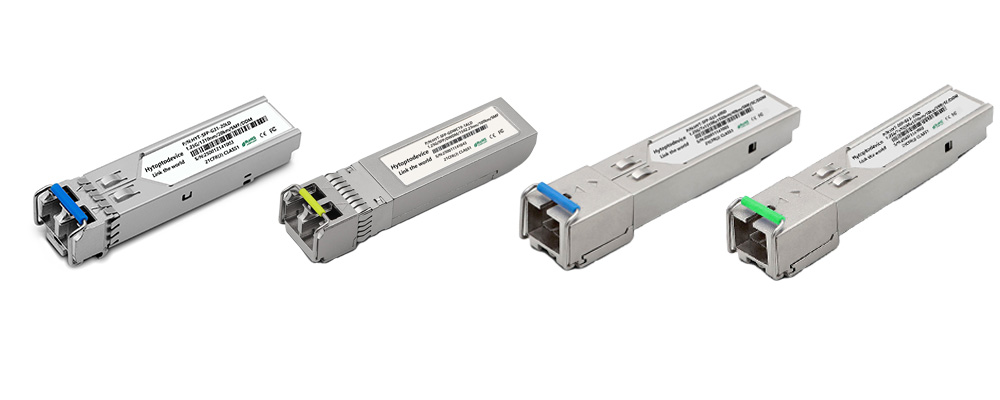
· SX: 1G, short-range (550m) over multimode fiber.
· LX/LH: 1G, long-range (10km+) over single-mode fiber.
· EX/ZX: 1G, extended long-range (40km, 80km) over single-mode fiber.
· RJ45 (Copper): 1G, up to 100m over Cat5e/Cat6.
· SFP+ (Enhanced SFP): The direct successor for 10 Gigabit Ethernet speeds.
· CWDM/DWDM: For multiplexing multiple signals on a single fiber strand for increased capacity.
In summary, SFP modules are the essential, adaptable workhorses that provide the physical connectivity for modern high-speed networks, allowing administrators to customize links for distance, media, and bandwidth with great efficiency. HYTOPTODEVICE, a professional optical module manufacturer based in Shenzhen, China, with over 15 years of production experience, will provide high-quality optical modules and other optical communication products to users worldwide.
Next
Silicon Photonics: Revolutionizing Optical Transceivers for High-Speed Data Centers
Read More



