10G SFP+ optical transceivers remain the most stable, cost-effective, and widely deployed form factor for enterprise LAN upgrades, ISP aggregation networks, and SAN storage interconnections in 2026. While 25G/100G hardware continues to iterate, most medium and small-scale data centers, campus networks, and industrial Ethernet projects still rely heavily on reliable 10G SFP+ links for daily operation.
Table of Contents
Why Careful SFP+ Module Specification Matters for 2026 Network Projects
10G SFP+ optical transceivers remain the most stable, cost-effective, and widely deployed form factor for enterprise LAN upgrades, ISP aggregation networks, and SAN storage interconnections in 2026. While 25G/100G hardware continues to iterate, most medium and small-scale data centers, campus networks, and industrial Ethernet projects still rely heavily on reliable 10G SFP+ links for daily operation.
The biggest pain point for network engineers and system integrators is not finding cheap SFP+ modules, but selecting compatible, project-matching, risk-free 10G SFP+ transceivers that avoid port errors, link flapping, and long OEM lead times. Choosing the wrong module leads to on-site rework, budget waste, and delayed project delivery.
This practical 2026 SFP+ buying guide helps you spec the correct transceiver for your exact network scenario, eliminate compatibility risks, and cut unnecessary OEM project costs. All reference modules recommended in this article are fully verified and stocked by HYTOPTODEVICE, a professional third-party optical transceiver manufacturer providing real-device testing, stable bulk supply, and fast global delivery.
SFP vs SFP+ Module Distinction: Critical Details Before Bulk Procurement
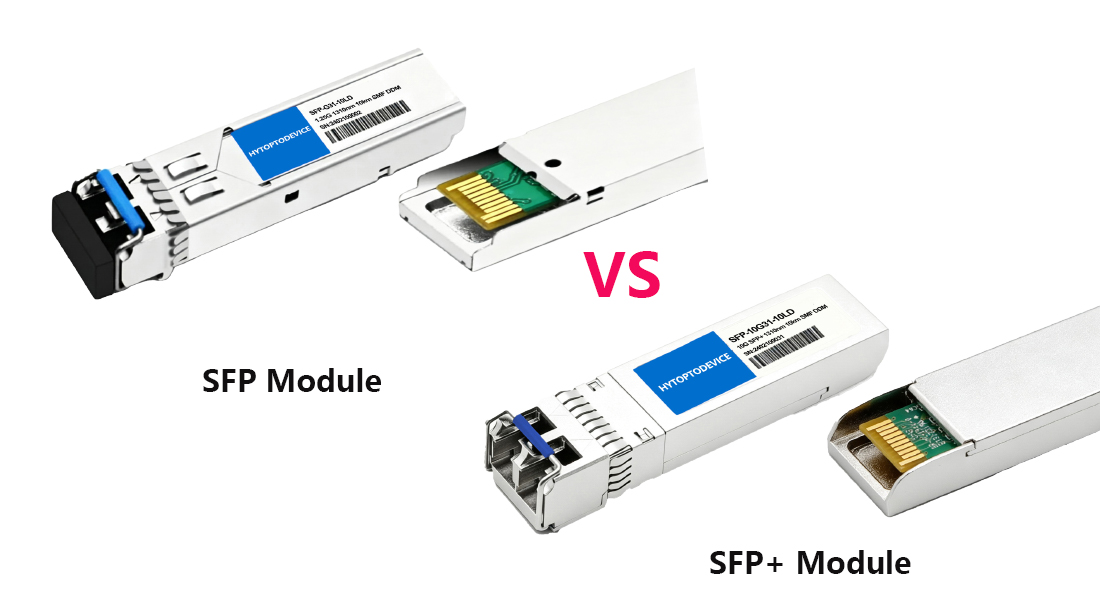
Many network buyers confuse SFP and SFP+ ports due to their identical physical appearance. Although SFP and SFP+ share the same cage size and external interface, their internal electrical specifications and bandwidth support are completely different.
Standard SFP modules support a maximum bandwidth of 1.25G, while SFP+ transceivers comply with the SFF-8431 standard and support stable 10G high-speed transmission. A key deployment rule: SFP ports cannot run SFP+ modules, but SFP+ ports are backward compatible with ordinary 1.25G SFP modules.
Before placing bulk orders, always confirm your switch port specification through official datasheets instead of judging by physical appearance only. This avoids bulk return losses caused by mismatched port rates. HYTOPTODEVICE provides professional port matching consultation to help customers avoid SFP/SFP+ specification mismatching errors.
Five Core Criteria to Confirm When Picking Suitable SFP+ Optics
To select a stable and cost-efficient 10G SFP+ transceiver for your 2026 network upgrade, you need to confirm five core parameters: transmission reach, working wavelength, fiber cable type, network protocol, and host device compatibility. These five factors determine whether the module can run stably long-term.
1. Confirm Required Fiber Transmission Span
Matching the correct transmission distance according to your actual link span is the first step to avoid network instability. Excessively short reach causes packet loss and disconnection; overly long reach wastes budget and may lead to optical overload without attenuation.
Undershooting reach on a long-haul link causes intermittent errors. Overshooting on a short link wastes budget and can introduce optical overload if you skip attenuation. Match the spec to your actual link distance.
2. Wavelength Options: Standard SM vs CWDM vs DWDM Layout
Standard
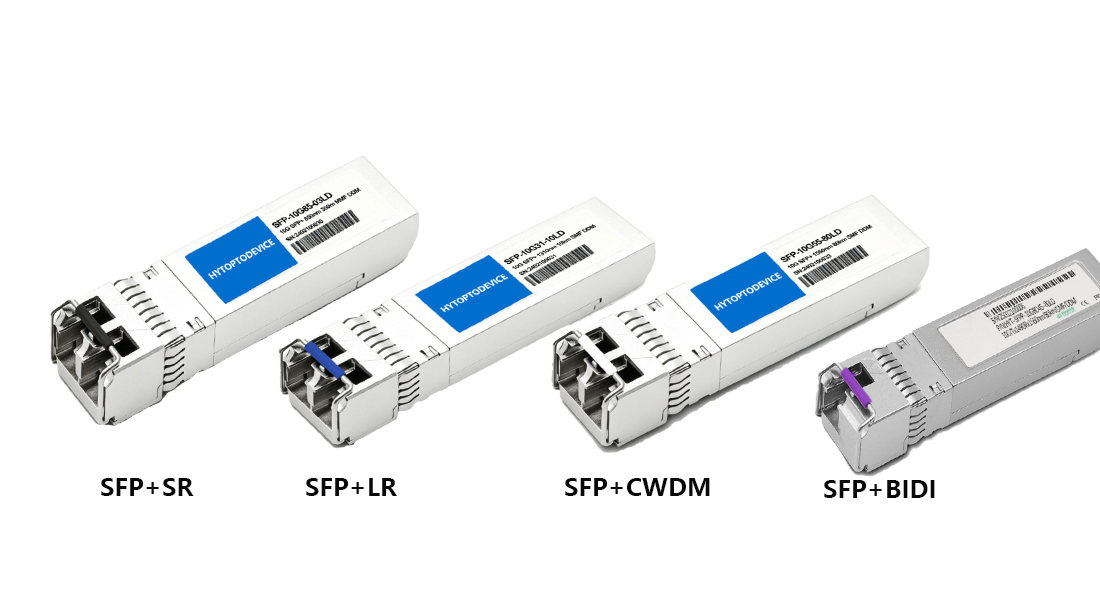
10G SFP+ LR modules adopt 1310nm universal wavelength, suitable for most point-to-point 10KM short and medium-distance enterprise links with low cost and strong compatibility.
For projects requiring multi-wavelength multiplexing on a single fiber pair,
10G CWDM SFP+ transceivers are the most cost-effective solution. With 20nm wavelength spacing covering 1270nm–1610nm, they support 18-channel multiplexing without expensive DWDM equipment, ideal for enterprise multi-service bearer and private network expansion.
HYTOPTODEVICE full-range 10G CWDM SFP+ modules cover 10KM, 20KM, 40KM, 80KM, and 100KM specifications for diversified medium and long-distance deployment needs:
https://www.hytoptodevice.com/collections/10gsfp
10G DWDM SFP+ transceivers adopt precise ITU-T C-band 0.8nm ultra-fine spacing, supporting 40+ wavelength multiplexing. They are the preferred solution for high-density carrier metro rings, ISP long-distance transmission, and large-scale operator backbone networks. HYTOPTODEVICE supplies stable 40KM/80KM/100KM DWDM SFP+ with full wavelength inventory:
https://www.hytoptodevice.com/collections/10g-dwdm-sfp
For non-multiplexing simple point-to-point links, standard 1310nm LR modules are sufficient to avoid over-specification and budget waste.
3. Match Transceiver with Installed Fiber Category
Fiber type mismatch is the top cause of 10G SFP+ link failure in actual deployment.
- OM3/OM4 Multimode Fiber (MMF): Only applicable for 10G SFP+ SR short-distance transmission within 300 meters, widely used for in-data-center cabinet interconnection and short-building links.
- OS2 Single-Mode Fiber (SMF): Mandatory for all links over 300 meters, including LR, CWDM, and DWDM long-distance modules, ensuring low attenuation and stable long-distance transmission.
Always verify your on-site fiber type before purchasing SFP+ transceivers to eliminate invisible network hidden dangers.
4. Confirm Working Protocol for Target Network Setup
Most users only focus on 10G rate but ignore protocol matching, resulting in module inability to be online normally. Different network scenarios correspond to different dedicated protocol SFP+ modules.
5. Verify Interoperability with Your Existing Network Hardware
Vendor EEPROM lock is the biggest compatibility obstacle for third-party SFP+ transceivers in 2026. Even with qualified optical and electrical parameters, unprogrammed modules will trigger "unsupported transceiver" errors on Cisco, Juniper, Arista, and Huawei devices.
Professional pre-programmed EEPROM and real-device testing are the core guarantees of compatibility.
HYTOPTODEVICE 10G SFP+ transceivers support 100% compatibility with 150+ mainstream network brands. Every module undergoes real switch and real router testing, with public compatibility test videos available for verification before purchase, completely eliminating third-party module compatibility anxiety.
Aftermarket Compatible Optics vs Brand OEM: Hidden Project Cost Breakdown
Genuine OEM Cisco, Juniper, and Arista 10G SFP+ transceivers are priced at $200–$500 per unit, with long production cycles and inflexible supply. For medium and large-scale 10G port deployment, OEM modules bring huge CAPEX pressure for network projects.
High-quality aftermarket compatible SFP+ transceivers from formal manufacturers have completely consistent optical power, sensitivity, and stability with OEM modules, with comprehensive cost savings of 70%–90%. Taking a 48-port switch deployment as an example, third-party modules can save thousands of dollars in project costs without sacrificing network performance.
The core risk of third-party modules lies in compatibility uncertainty, which HYTOPTODEVICE completely solves through
public real-machine compatibility test videos:
https://www.hytoptodevice.com/pages/compatibility-video. Buyers can watch actual running tests on corresponding brand devices in advance to ensure zero-risk deployment.
Single-Fiber BiDi SFP+: Ideal Pick to Cut Dark Fiber Deployment Expense
Traditional duplex SFP+ modules occupy two fiber strands for one link, which is extremely wasteful for scenarios with insufficient fiber resources or expensive dark fiber leasing.
10G BiDi SFP+ transceivers adopt single-fiber bidirectional transmission technology, using different wavelengths for sending and receiving signals, which can save 50% of fiber resources. It is the best cost-saving solution for FTTH access, campus network renovation, and fiber-limited old building network upgrades.
Note that BiDi modules must be used in paired wavelength combinations; mismatched TX/RX wavelengths will cause link failure. HYTOPTODEVICE provides complete matched 10G BiDi SFP+ series specifications and pairing guidance:
https://www.hytoptodevice.com/collections/10g-bidi-sfp
Fibre Channel SFP+ Buying Tips for Dedicated SAN Storage Infrastructure
SAN storage networks have stricter requirements on module latency, jitter, and credit management than ordinary Ethernet networks. 8G/16G Fibre Channel SFP+ modules are professionally coded for storage scenarios and cannot be replaced by ordinary 10G Ethernet modules, even with the same rate.
Improper module selection will lead to storage packet loss, disk array disconnection, and data transmission anomalies. For HBAs, FC switches, and SAN cross-rack interconnection, please select dedicated storage-grade SFP+ transceivers to ensure stable data storage and backup.
Step-by-Step Checklist to Confirm Transceiver Interoperability Pre-Installation
For network integrators and enterprise purchasers, standardized pre-deployment verification can completely avoid on-site failure risks of third-party SFP+ modules. The 2026 universal verification checklist is as follows:
- Confirm device platform and firmware version: Different IOS and firmware versions have different identification rules for third-party modules.
- Verify EEPROM programming information: Confirm that the module is pre-programmed with the corresponding vendor PN and ID to adapt to brand lock-in mechanisms.
- Watch official compatibility test videos: Check real running effects on target devices to eliminate theoretical compatibility errors.
- Download official datasheets for parameter comparison: Verify TX power, RX sensitivity, and link budget matching. All HYTOPTODEVICE product datasheets are available for free download: https://www.hytoptodevice.com/downloads
- Sample test before bulk deployment: Test single-module stability in the actual environment before large-scale batch deployment.
This process adds a day to your timeline and takes most compatibility risk off the table before it becomes a mid-deployment problem.
Common Buyer FAQs About 10G SFP+ Module Selection
Q1: Can pre-tested aftermarket 10G SFP+ optics run seamlessly on existing Cisco switching hardware?
A: Yes. Precisely EEPROM-programmed HYTOPTODEVICE SFP+ modules achieve 100% plug-and-play compatibility with Cisco IOS/IOS-XE systems. Most minor warning prompts do not affect operation, and we provide corresponding command solutions and real-device test videos to prove stability.
Q2: What practical deployment gaps exist between CWDM & DWDM 10G SFP+ for enterprise backbone links?
A: CWDM features low cost and simple deployment, suitable for small and medium-scale multi-wavelength multiplexing (within 18 channels). DWDM has ultra-high wavelength density, suitable for large carrier metro rings and long-distance high-capacity transmission. Enterprises with low channel demand prefer CWDM for higher cost performance.
Q3: Is physical insertion of 10G SFP+ optical module feasible on traditional 1G SFP hardware slots?
A: No. SFP electrical ports do not support 10G signal parsing. Only SFP+ ports are backward compatible with 1G SFP modules, and reverse compatibility is invalid.
Q4: Which transmission-range SFP+ optics fit regular ISP metro ring construction from 20km to 80km?
A: 10G CWDM SFP+ 40KM/80KM modules are the mainstream choice for medium and long-distance metro ring links. For high-density wavelength multiplexing scenarios, select matched DWDM SFP+ modules to improve fiber utilization.
Q5: How does single-fiber BiDi SFP+ save fiber resources & which on-site scenarios prefer this optic solution?
A: It is mainly used for scenarios with insufficient fiber resources, such as old campus network renovation, building interconnection, and FTTH broadband uplink. It saves half fiber resources and requires strict paired wavelength deployment.
Q6: How to complete accurate link budget calculation to match SFP+ specs with pre-laid field fiber cables?
A: Calculate your overall link budget including fiber attenuation, connector loss, and splice loss, and compare with the module’s TX/RX parameters. Download HYTOPTODEVICE official datasheets for accurate parameter verification before purchasing.
Q7: How much CAPEX can businesses save by replacing brand OEM SFP+ with qualified aftermarket compatible alternatives?
A: OEM 10G SFP+ modules from Cisco typically run $200 to $500 per unit. Third-party compatible modules from verified suppliers deliver the same optical performance at 70 to 90 percent lower cost. On a 48-port deployment, that savings is substantial. The way to manage compatibility risk is pre-deployment validation — not paying OEM prices.
Closing Advice on Cost-Efficient SFP+ Sourcing
In 2026, scientific SFP+ transceiver selection no longer relies on blind purchase or expensive OEM original modules. Accurate matching of transmission distance, wavelength type, fiber specification, network protocol, and device compatibility is the core of stable 10G network deployment.
As a reliable global optical transceiver supplier, HYTOPTODEVICE provides full-series verified 10G SFP+ solutions including standard LR, long-distance CWDM/DWDM, single-fiber BiDi, and dedicated Fibre Channel modules. All products pass real-device compatibility testing with public test videos, stable bulk supply, fast lead time, and professional pre-sales matching consultation, helping global network integrators and enterprise users complete low-cost, zero-risk 10G network upgrades.



