WDM (Wavelength Division Multiplexing) is a foundational technology in optical communications that dramatically increases the capacity of a single optical fiber by transmitting multiple data signals simultaneously, each on a distinct wavelength (or color) of light. It is the principle that enables modern high-bandwidth networks.HYTOPTODEVICE has been researching WDM for many years and has accumulated a wealth of successful case studies, which we would like to share with you today.
Table of Contents: 一、Core Concept: How WDM Works 二、Application in Modern Networks Wavelength Division Multiplexing(WDM) is the cornerstone technology powering our connected world. By enabling multiple data channels to travel simultaneously over a single optical fiber—each on a unique wavelength of light—WDM is the key to meeting today's insatiable demand for bandwidth. At HYTOPTODEVICE TECHNOLOGY, we provide the essential optical building blocks that make robust and scalable WDM networks a reality.
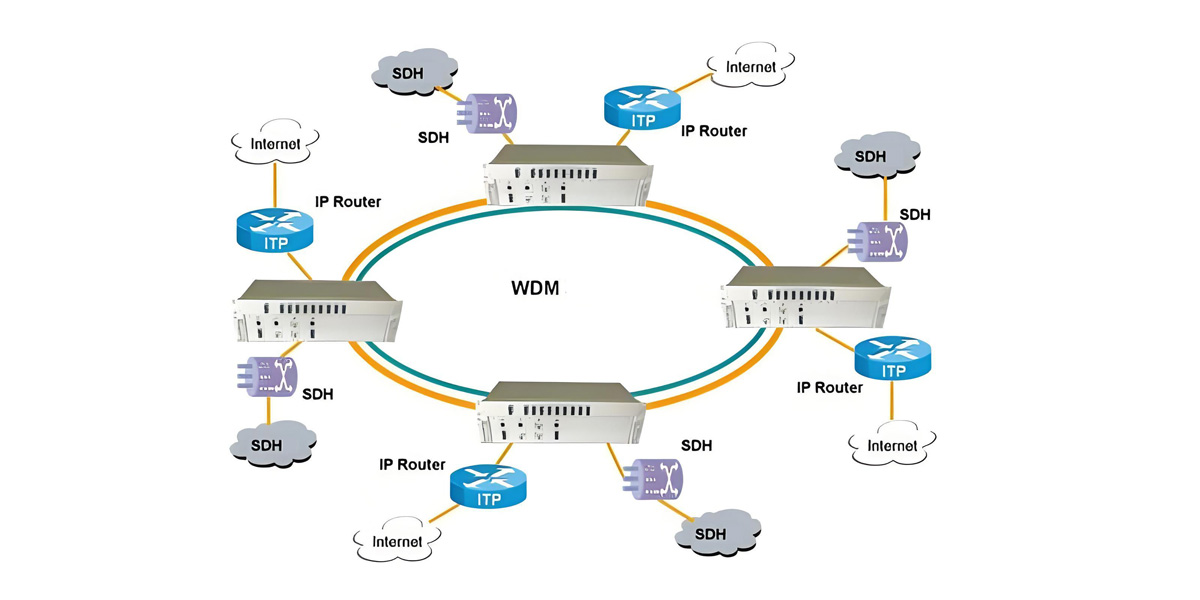 一、Core Concept: How WDM Works
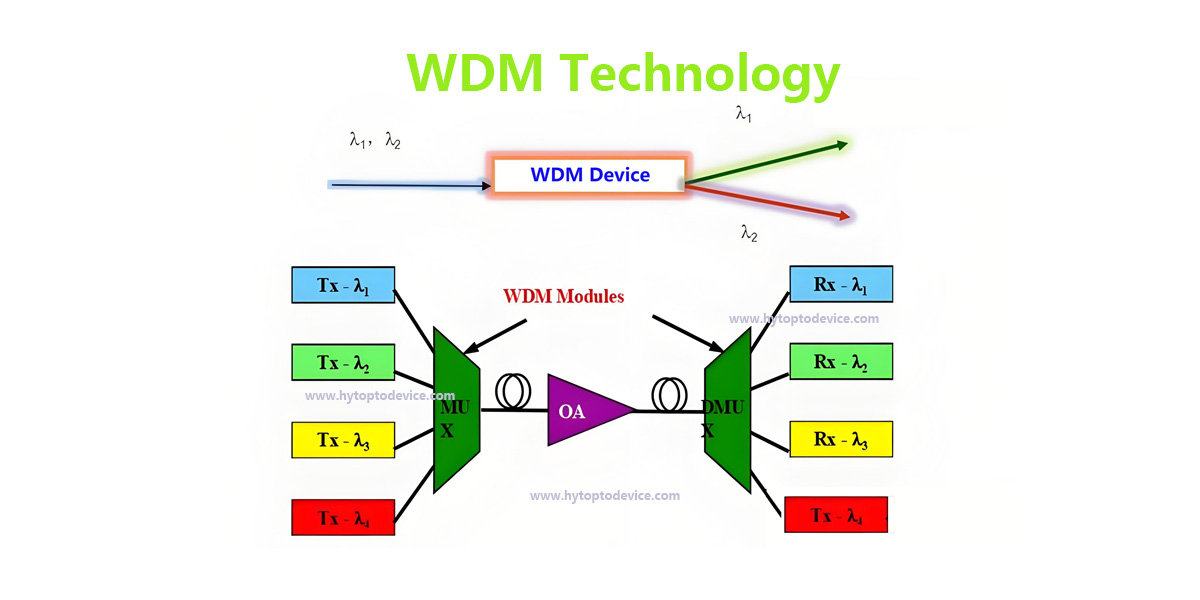
 Imagine a single fiber as a multi-lane highway, where each lane is a unique wavelength of light. WDM combines (multiplexes) several of these "optical lanes" at the transmitter and separates (demultiplexes) them at the receiver. This allows for independent data streams to coexist without interference.
1.Two Main Flavors: CWDM vs. DWDM
WDM is primarily implemented in two forms, which differ in channel spacing and application scope:
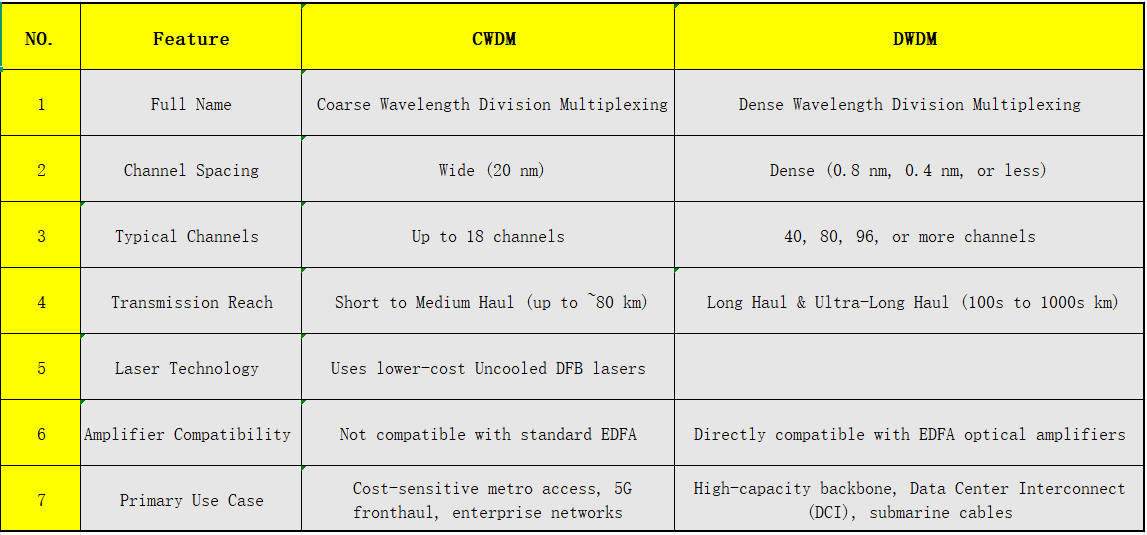
2.Key Advantages of WDM Technology:
Why WDM is the Smart Choice ?Beyond maximizing fiber capacity,deploying WDM technology offers strategic advantages:
· Future-Proof Investment: Scale your network capacity seamlessly by adding new wavelengths, without the high cost and disruption of installing new fiber cables.
· Unmatched Flexibility & Transparency: Carry diverse traffic types—from Ethernet and Fibre Channel to legacy SDH/SONET—simultaneously and independently on different wavelengths.
· Simplified Network Architecture: Reduce physical fiber count and complexity, leading to lower operational overhead and easier management.
· Maximizes Fiber Capacity: The most significant benefit, turning one fiber into many virtual fibers.
· Protocol Transparency: Can carry any data format (Ethernet, SDH/SONET, Fiber Channel) as each wavelength is independent.
· Scalability: New wavelengths (services) can be added without laying new fiber.
· Operational Efficiency: Reduces fiber count and simplifies network architecture.
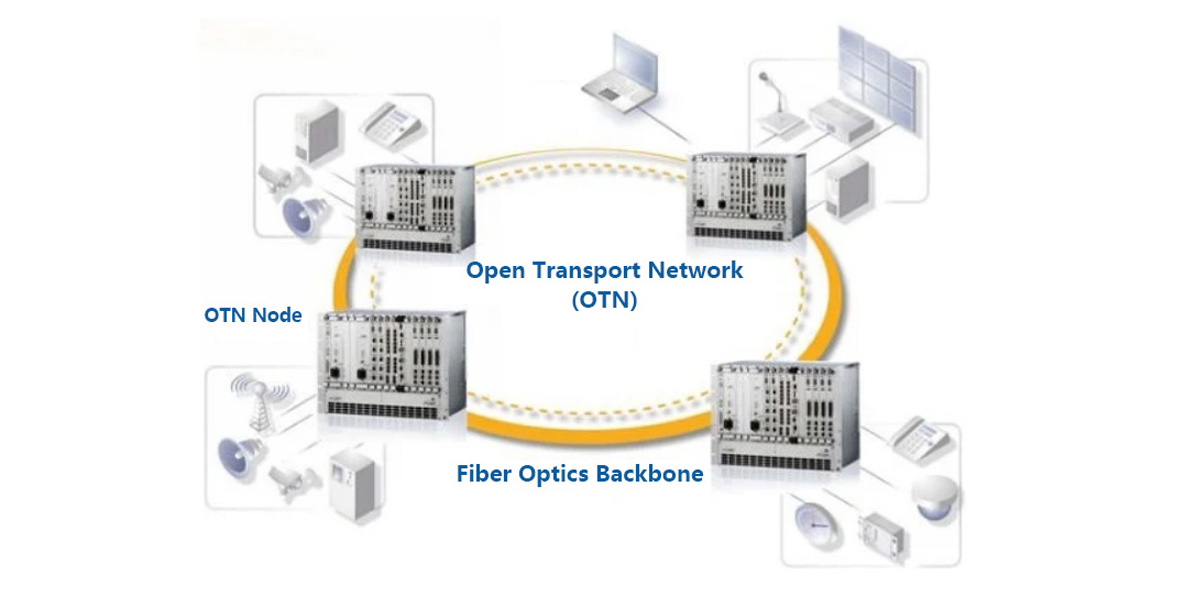 二、Application in Modern Networks
 WDM is not a standalone device but a system built using WDM optical modules (transceivers), multiplexers/demultiplexers (Mux/DeMux), and optionally amplifiers.
· An access network might use simple, passive CWDM to aggregate traffic from multiple buildings.
· A cloud provider would use high-capacity DWDM systems with 100G/400G coherent optics to link its data centers across continents.
The HYTOPTODEVICE TECHNOLOGY Advantage
As a specialist in optical modules, HYTOPTODEVICE TECHNOLOGY empowers your WDM deployment with:
· Full-Suite Products: We supply both CWDM and DWDM transceivers (SFP+, SFP28, QSFP28, QSFP-DD) for every network layer.
· Performance & Reliability: Our modules use industry-grade lasers (DFB/EML) to ensure stable operation over their specified lifetime and reach.
· Seamless Integration: Our optics are designed for multi-vendor compatibility with equipment from Cisco, Juniper, Arista, Nokia, Huawei, and others, ensuring smooth deployment and significant cost savings versus OEM modules.
In essence, WDM is the enabling technology for scalable optical networks. Choosing between CWDM and DWDM depends on your specific reach, capacity, and budget requirements.
Contact HYTOPTODEVICE TECHNOLOGY today to select the optimal WDM solution for your project.



