
Table of Contents
1.The Great Divide: Why 6G Was Stuck
2. Creating Three World Records and a New Path Forward
3.Solving the Three Core Challenges
3.1.Bridging the Architectural Chasm
3.2.Breaking the Bandwidth-Performance Trade-off
3.3.Conquering System Complexity and Signal Damage
4.The Disruptive Innovations: A Triple Breakthrough
4.1.System Architecture: "One System, Multiple Scenarios"
4.2.AI-Powered Algorithms: Conquering Channel Impairments
4.3.Hardware Breakthrough: The Ultra-Wideband Integrated Photonic Device
4.4. Energy Efficiency, Cost, and Scalability
5.What This Means for the Industry and HYTOPTODEVICE
5.1. Next-Generation Optical Transceivers
5.2. Fiber-Wireless Convergence Solutions
5.3. AI Data Center Connectivity
5.4. 6G Infrastructure Deployment
5.5.The HYTOPTODEVICE Commitment
6.Conclusion: A New Era for Optical Communication
1.The Great Divide: Why 6G Was Stuck
The deep integration of optical communication and wireless transmission has long been recognized as the inevitable path toward 6G. Yet, a fundamental problem persisted: architectural fragmentation.
Fiber optics relies on baseband signal processing.
Wireless communication depends on intermediate frequency (IF) transmission.
These two worlds speak different languages. They operate on incompatible hardware constraints and signal architectures. This "bandwidth gap" has caused transmission bottlenecks, high cross-domain conversion latency, and excessive deployment costs. The dream of a unified network—where the radio access network (RAN) and the optical backbone truly merge—remained just that: a dream.
Until now.
2. Creating Three World Records and a New Path Forward
The Nature Paper:The Chinese team's breakthrough doesn't just improve existing technology—it re-architects the entire foundation of how fiber and wireless interact. All three peer reviewers of Nature praised the work, noting that it sets three new world records and makes significant contributions to the advancement of integrated optical/terahertz communication systems.
But what makes this truly "disruptive" is how it solves the three core challenges that have stumped the industry for years.
3.Solving the Three Core Challenges
3.1.Bridging the Architectural Chasm
For the first time, the team eliminated the underlying architectural fragmentation between fiber and wireless. By developing a unified hardware and signal processing framework, they enabled a single infrastructure to handle both domains efficiently.
The Old Way: Separate systems for fiber and wireless, requiring complex conversions.
The Breakthrough: A unified architecture that eliminates cross-domain delays and drastically reduces deployment complexity.
3.2.Breaking the Bandwidth-Performance Trade-off
Traditional electro-optic modulators faced an impossible choice: high bandwidth or high efficiency? Traveling-wave photodiodes suffered from the tug-of-war between bandwidth and saturation output power.
The team's integrated photonics approach achieved:
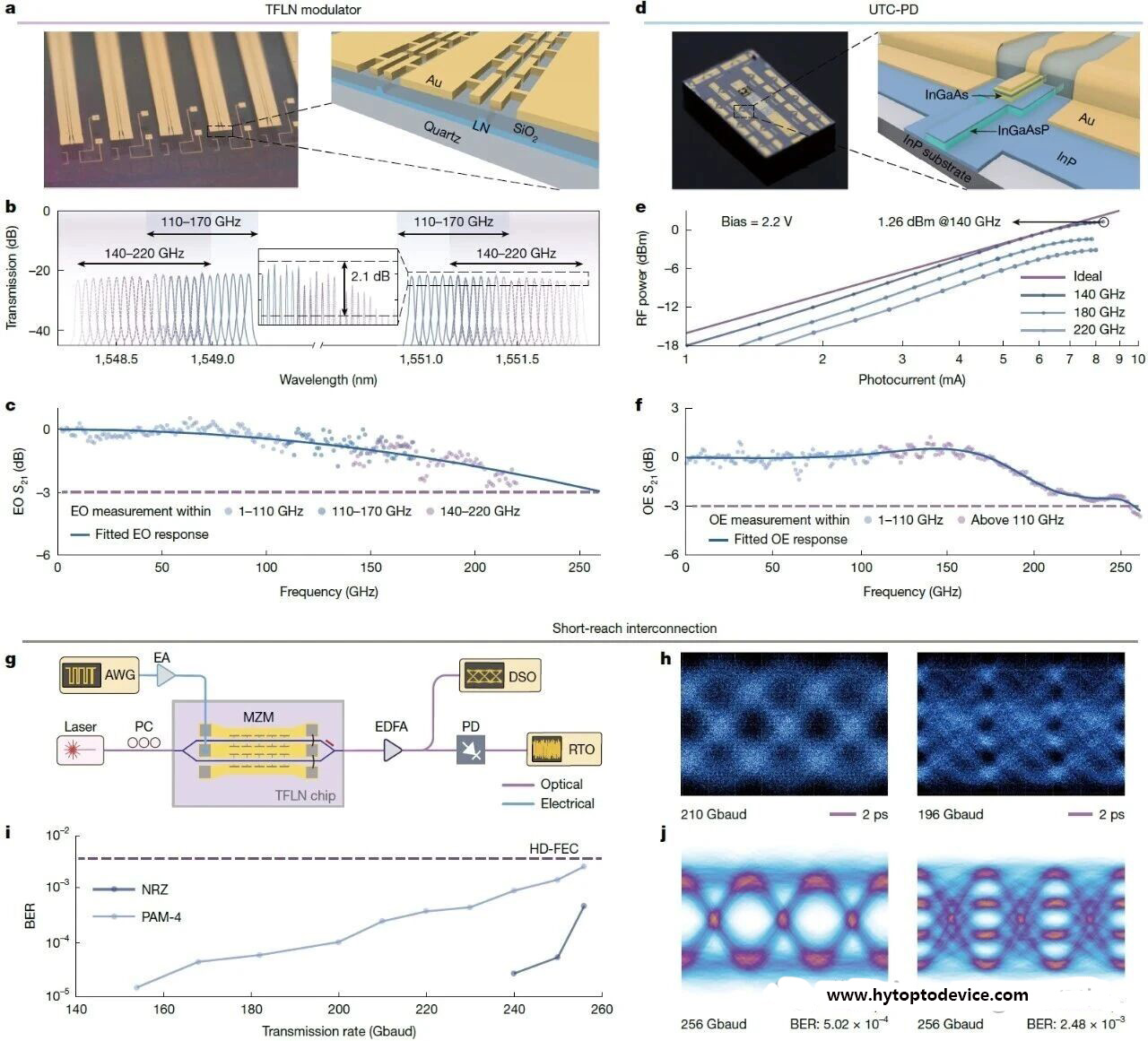
Electro-optic modulators with >220 GHz (measured 3dB bandwidth), and on-chip insertion loss as low as 0.6dB—the highest publicly reported bandwidth for (similar devices).
Modified photodiodes with >250 GHz bandwidth and high saturation output power, breaking the performance ceiling that has limited high-speed communication development.
3.3.Conquering System Complexity and Signal DamageAs signal bandwidth pushes toward the hundreds of gigahertz, traditional electrical frequency conversion introduces noise accumulation and hardware bloat. Linear digital signal processing algorithms simply fail.
The team's solution? A photonics-first approach that eliminates these limitations while maintaining signal integrity.
4.The Disruptive Innovations: A Triple BreakthroughThe team proposed the world's first integrated fiber-wireless architecture. This isn't just incremental improvement—it's fundamental rethinking.
What it means:
The same ultra-wideband integrated photonic hardware serves all scenarios: fiber (short-distance interconnection), terahertz wireless transmission, and fiber-wireless transparent relay.
No need to build separate infrastructures for fiber and wireless.
-Mobile access networks and optical backbone networks can finally achieve deep unification.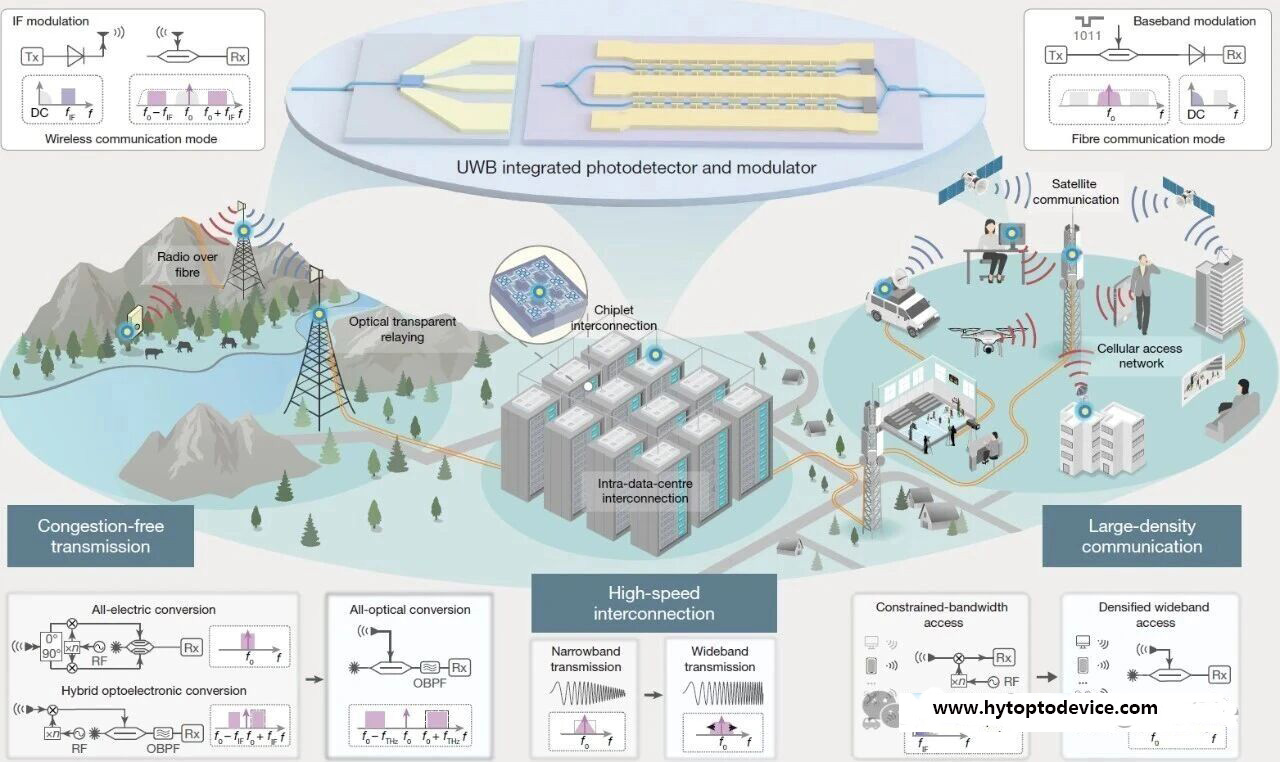
In the algorithm layer, the team applied AI deep learning to channel equalization. They developed a novel complex bidirectional gated recurrent unit (complex-biGRU) digital signal processing algorithm.
Why it matters:
Extends traditional GRU networks to the complex domain for coherent optical communication.
Significantly improves adaptation to linear and nonlinear impairments in ultra-wideband transmission.
Overcomes the fundamental failure of traditional equalization algorithms in hundred-gigahertz ultra-wideband scenarios.
The results speak for themselves:
Short-distance fiber links: 512 Gbps per channel
Terahertz wireless links: 400 Gbps per channel
First time both fiber and wireless have simultaneously achieved >400 Gbps per channel transmission.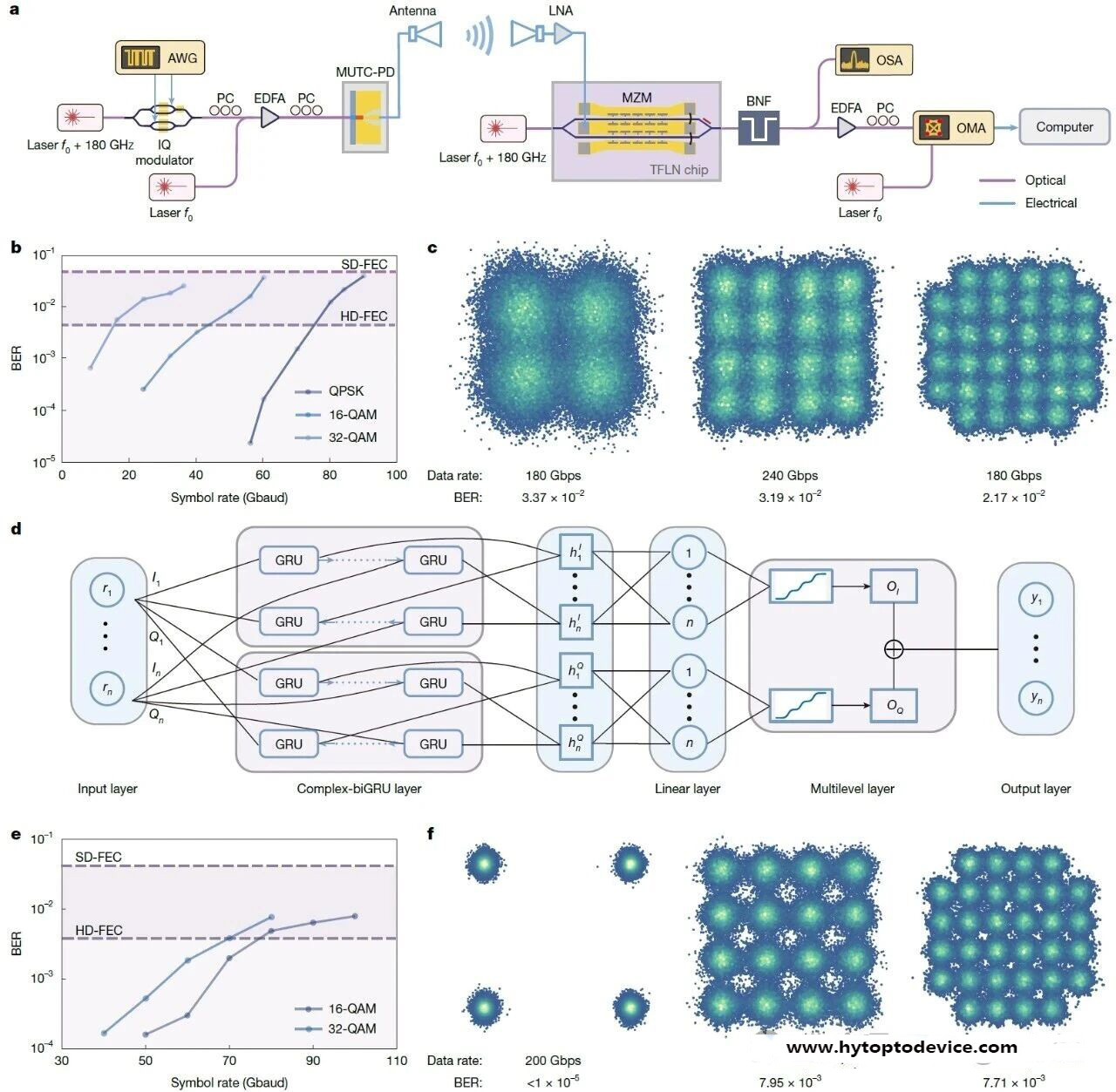
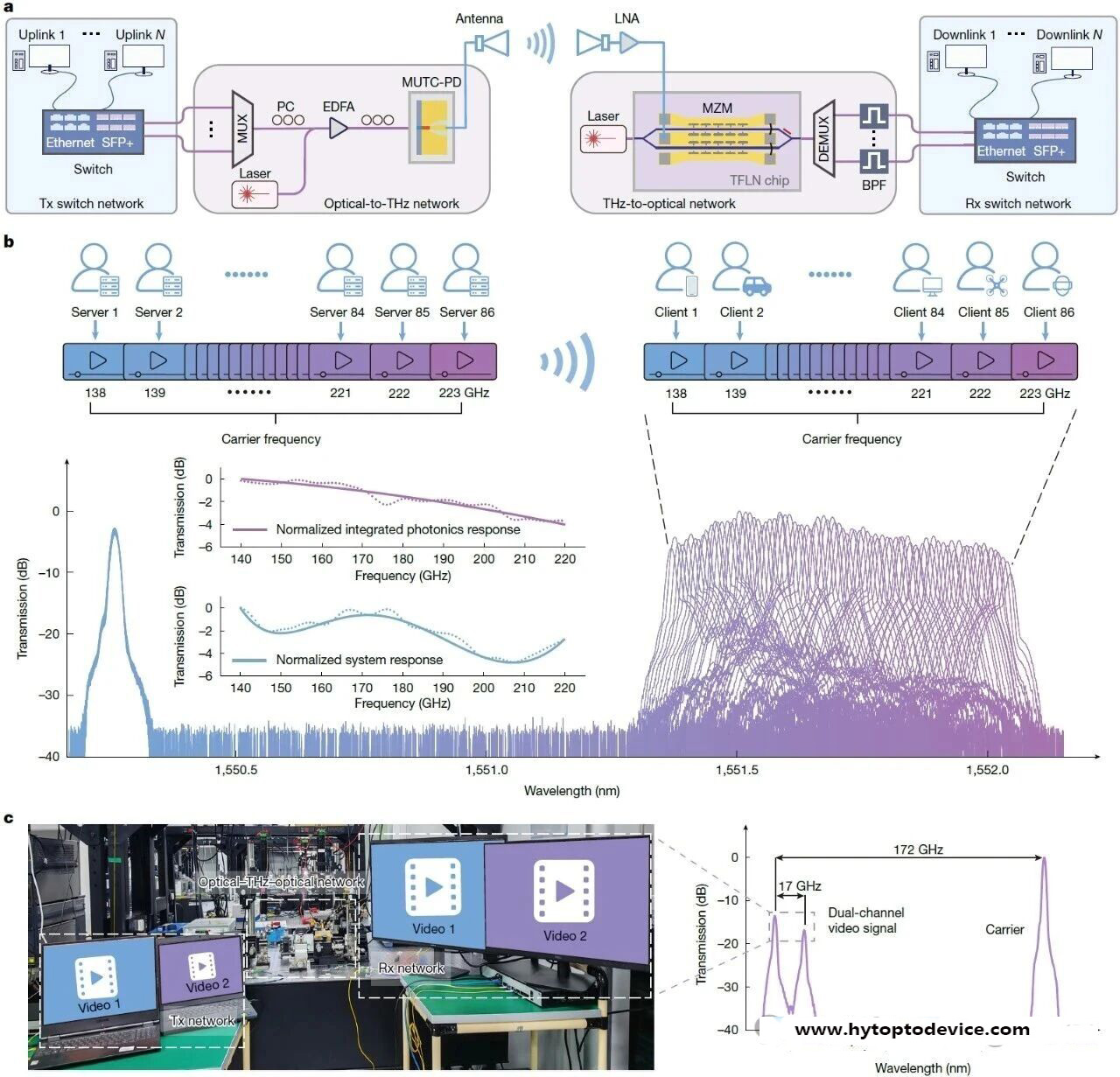
At the heart of the system lies the hardware breakthrough. Based on advanced thin-film lithium niobate materials and improved uni-traveling carrier photodetector structures, the team achieved:
>250 GHz broadband flat electro-optic-electro conversion links
>100 GHz (usable signal bandwidth) in both wired and wireless frequencies
Elimination of bandwidth limitations and noise accumulation inherent in traditional electrical frequency multiplication chains
Key device specifications:
| Component | Key Metrics | Breakthrough Significance |
| Thin-film lithium niobate electro-optic modulator | >220 GHz 3dB bandwidth, 0.6dB insertion loss, ±2.1dB fluctuation (110-220GHz) | Highest publicly reported bandwidth for similar device |
| Modified InP-based uni-traveling carrier photodiode | >250 GHz 3dB bandwidth, 1.26dBm RF output power @140GHz | Breaks bandwidth-power trade-off ceiling |
This breakthrough isn't just about speed records. It excels in the metrics that matter for real-world deployment:
Energy Efficiency:
Low insertion loss and high saturation output power reduce the need for high-power amplification units
-Power consumption optimization starts at the hardware level
Cost Control:
All-optical architecture eliminates large quantities of RF cables and electrical mixers
Core devices use standardized semiconductor processes—no custom fabrication required
Significantly reduces deployment and maintenance costs
Scalable Deployment:
Device parameters fully compatible with commercial wafer-level manufacturing
All-optical architecture seamlessly integrates with existing global fiber networks
-No disruptive transformation needed—high implementation feasibility
For companies like HYTOPTODEVICE, this breakthrough opens new horizons. As a professional manufacturer of optical transceivers, DAC, and AOC solutions, we have long been committed to R&D, production, and sales of optical communication products, staying at the forefront of industry technology.
This integrated photonics breakthrough will drive demand for:
The >400 Gbps per channel capability demonstrated by the research team points toward optical transceivers that must keep pace. Future 6G networks will require:
Ultra-high-speed optical modules
Low-latency, high-bandwidth solutions
Seamless integration with wireless infrastructure
As the research shows, "one system, multiple scenarios" is the future. This means:
Optical transceivers must be designed with wireless convergence in mind
DAC and AOC solutions need to support hybrid fiber-wireless architectures
Standardization around unified hardware platforms
The breakthrough's implications for AI data centers are profound:
512 Gbps short-distance fiber links enable faster AI model training
Reduced latency for distributed computing
Lower power consumption for large-scale deployment
The system provides core solutions for:
6G Macro and micro base stations fiber-wireless integrated deployment
Wireless data center high-speed optical interconnection
Signal relay coverage in remote areas and harsh environments
Beyond telecommunications, the technology foundation can extend to:
Terahertz high-resolution radar
Industrial non-destructive testing
Biomedical spectral imaging
At HYTOPTODEVICE, we recognize that breakthroughs like this don't just change the technology landscape—they reshape the entire industrial ecosystem). As aprofessional original manufacturer of optical transceivers and connectivity solutions, we are committed to:
Closely tracking advanced industry technology
Developing products that align with next-generation network architectures
Providing cost-effective, scalable solutions for the 6G era
Supporting the seamless integration of optical and wireless networks
The Nature paper published on February 19 represents more than just a scientific achievement. It is a roadmap for the future of telecommunications. By solving the architectural divide between fiber and wireless, achieving breakthrough device performance, and demonstrating AI-powered signal processing, the Chinese research team has opened a new path toward 6G.
For the optical communication industry—and for companies like HYTOPTODEVICE that power this ecosystem—the message is clear: the future is integrated, ultra-wideband, and unified. And it's arriving faster than we thought.


