Originally deployed in long-haul backbone and transoceanic communication systems, coherent optical communication has been the cornerstone of ultra-long-distance, high-capacity data transmission over fiber optics. With decreasing costs, this advanced technology is now expanding into new frontiers such as data center interconnects (DCI) and next-generation access networks like 100G+ PON. But what exactly is coherent optical communication, and why is it becoming essential across network layers?
Table of Contents
一、What is Coherent Optical Communication?
二、How It Works: The Coherent Detection Process
三、Conditions for Effective Coherence
四、Coherent Optical Communication System Architecture
五、Why Use Coherent Optical Communication? Key Advantages
六、Conclusion
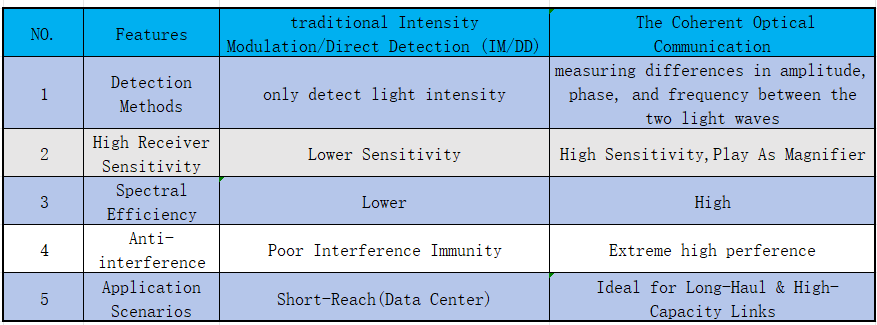
一、What is Coherent Optical Communication? The coherent optical communication is a method that utilizes coherent detection technology. At its core lies the use of a local oscillator (LO) laser at the receiver. This LO generates a reference light wave that mixes coherently with the incoming signal light. Unlike traditional Intensity Modulation/Direct Detection (IM/DD) systems—which only detect light intensity—coherent detection extracts information by measuring differences in amplitude, phase, and frequency between the two light waves.
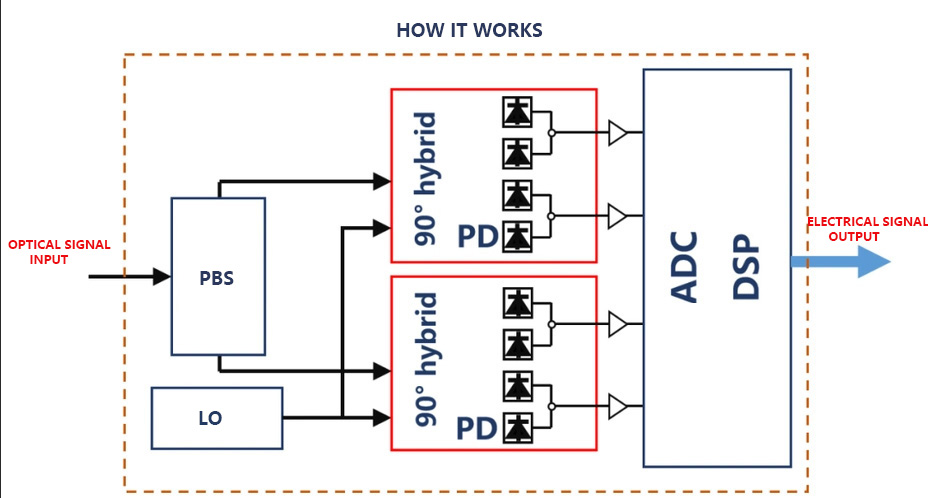
二、How It Works: The Coherent Detection Process1. Two Input Light Signals
· Signal Light: A weak optical signal carrying data, transmitted through the fiber.
· Local Oscillator Light: A pure, stable reference light generated by a laser at the receiver, with a frequency very close to that of the signal light.
2. Coherent Mixing
Both lights are combined in an optical mixer. Due to the wave nature of light, they interfere with each other.
3. Information Extraction
PBS. the mixed light is converted into an electrical signal via balanced photodetectors. This electrical signal retains the amplitude, phase, and polarization differences between the signal and LO light.
4. Digital Signal Processing (DSP)
This is the most critical step. A powerful DSP chip applies sophisticated algorithms to compensate for transmission impairments such as chromatic dispersion, polarization mode dispersion, and phase noise, ultimately recovering the original data accurately.
 三、Conditions for Effective Coherence
 For the LO and signal light to interfere effectively, they must satisfy three conditions:
· Frequency Matching: Their frequencies must be highly aligned.
· Stable Phase Difference: The phase difference between them must remain constant.
· Polarization Alignment: Their polarization states must match; otherwise, signal degradation occurs. Modern systems use polarization diversity or control techniques to manage this.
In practice, these stringent conditions are dynamically maintained and compensated by advanced DSP technology, making commercial deployment feasible.
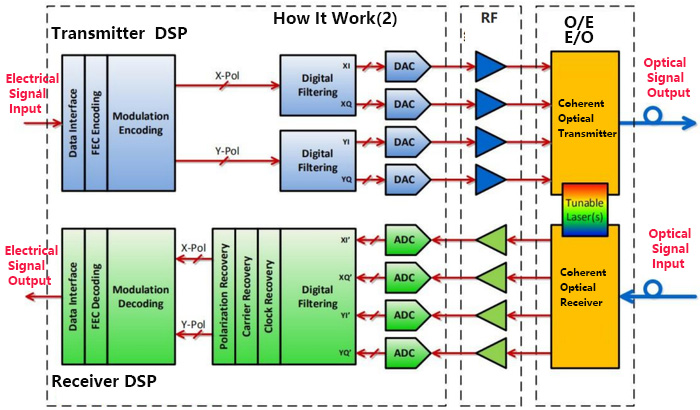
四、Coherent Optical Communication System ArchitectureA typical coherent system consists of a transmitter and a receiver:
1.Transmitter Side
· Tunable Narrow-Linewidth Laser (ITLA): Provides a stable, precise light source.
· Coherent Driver Modulator (e.g., IQ Modulator): Modulates electrical data onto the optical carrier’s amplitude and phase.
2.Receiver Side
· Local Oscillator Laser
· Optical Mixer
· Balanced Photodetectors
· DSP Chip: Performs dispersion compensation, clock recovery, polarization demultiplexing, carrier phase recovery, and more.
五、Why Use Coherent Optical Communication? Key Advantages Compared to traditional IM/DD systems, coherent technology offers significant benefits:
· High Receiver Sensitivity: Coherent detection improves signal-to-noise ratio (SNR) by about 20 dB over IM/DD, greatly extending transmission reach and power budget.
· High Spectral Efficiency: Using advanced modulation formats (e.g., QPSK, 16-QAM, 64-QAM), it carries more bits per symbol, enabling higher capacity within the same bandwidth.
· Strong Resilience to Impairments: Integrated DSP effectively compensates for linear impairments like chromatic dispersion and polarization mode dispersion, and offers better tolerance to nonlinear effects.
· Ideal for Long-Haul & High-Capacity Links: The preferred solution for backbone, metro, and DCI applications requiring distances from tens to thousands of kilometers.
 六、Conclusion
 Coherent optical communication unlocks the phase and polarization dimensions of light, combined with powerful real-time DSP, to achieve remarkable leaps in capacity, reach, and reliability. It is a foundational technology for modern high-speed optical networks.
As costs decline and integration improves, coherent technology is steadily moving beyond long-haul into metro, data center interconnects, and even future high-speed access networks—making it a key enabler for the next generation of global connectivity.
HYTOPTODEVICE, an optical communication manufacturer with over 15 years of industry experience, keeps abreast of cutting-edge technologies and has accumulated rich industry expertise. We can provide technical and product support in coherent optical communication, such as coherent optical modules. Interested parties are welcome to contact us at any time.



